
We don’t know how Grigulevich got from Moscow to Mexico, but in between, he was in New Mexico. That’s probably where he got his newest alias. According to a Soviet spy cable on June 29, 1938: “Yusik (Grigulevich’s code name) worked as an illegal in Mexico using a document of a US born Spaniard. On Trotsky. Manuel Francis Rodrigez (the u is missing from the usual spelling of Rodriguez), born 1910 (three years older than Grigulevich).”
Most longtime Hispanic New Mexicans, then and now, identify themselves as Spanish — “Spaniard” in the translated cable — rather than Mexican because their ancestors arrived when New Mexico was a Spanish colony. The cable says he was “US born.”
The middle name — Francis — is a man’s given name, not a surname. The use of the given name in the middle indicates one’s parents used the English or U.S. style with the father’s surname at the end and the mother’s surname absent. In the formal Spanish style, the father’s surname is in the middle and the mother’s surname comes last. New Mexican Hispanics typically use the U.S. style.
Misspellings — Rodrigez — are common in the documents of people who want to be in the shadows. An error, even transposed letters, sows confusion into identifications. One sees it in forms filled out by gangsters. Trotsky’s eventual assassin used the alias Frank Jacson — without the usual k.
Why Santa Fe? Siqueiros probably suggested it. He had stopped there before on the train between Los Angeles and Chicago. He wouldn’t be ready for the Trotsky job for more than a year. Grigulevich needed somewhere to cool his heels outside of Mexico, yet close enough for trips. Santa Fe is 1,200 miles from Mexico City. Santa Fe looked like a town in Latin America or Spain and most of its 30,000 residents spoke Spanish. Grigulevich was just beginning to learn English.
Grigulevich did not need a job to survive. But knowing he would need to spend some time in Santa Fe, he wanted to fit in. He wasn’t a pharmacist but he knew the business from working with his father. At Zook’s Pharmacy, 56 E. San Francisco, he would have found Katherine “Katy” Zook, daughter of the owners, working the cash register. Katy had a dancer’s posture, red hair and long braids coiled around her head. I have never found a photograph, but I picture her looking like Katharine Hepburn. She was single and liked to travel. In 1938, she turned 31; Grigulevich was 25. Back in La Clarita, some recall him looking like Clark Gable.
In his 2011 spy’s guide to Santa Fe and Albuquerque, former CIA agent E.B. Held speculated that Grigulevich struck up a romance with Katy after insinuating himself into the family via his mutual Lithuanian roots with pharmacy founder John Zook. John had Lithuanian ancestry but he was born in Pennsylvania. I doubt Grigulevich would have shared his true background with anyone. But a fling with Katy wouldn’t surprise me. She might have liked the sophisticated young man with an Argentine accent.
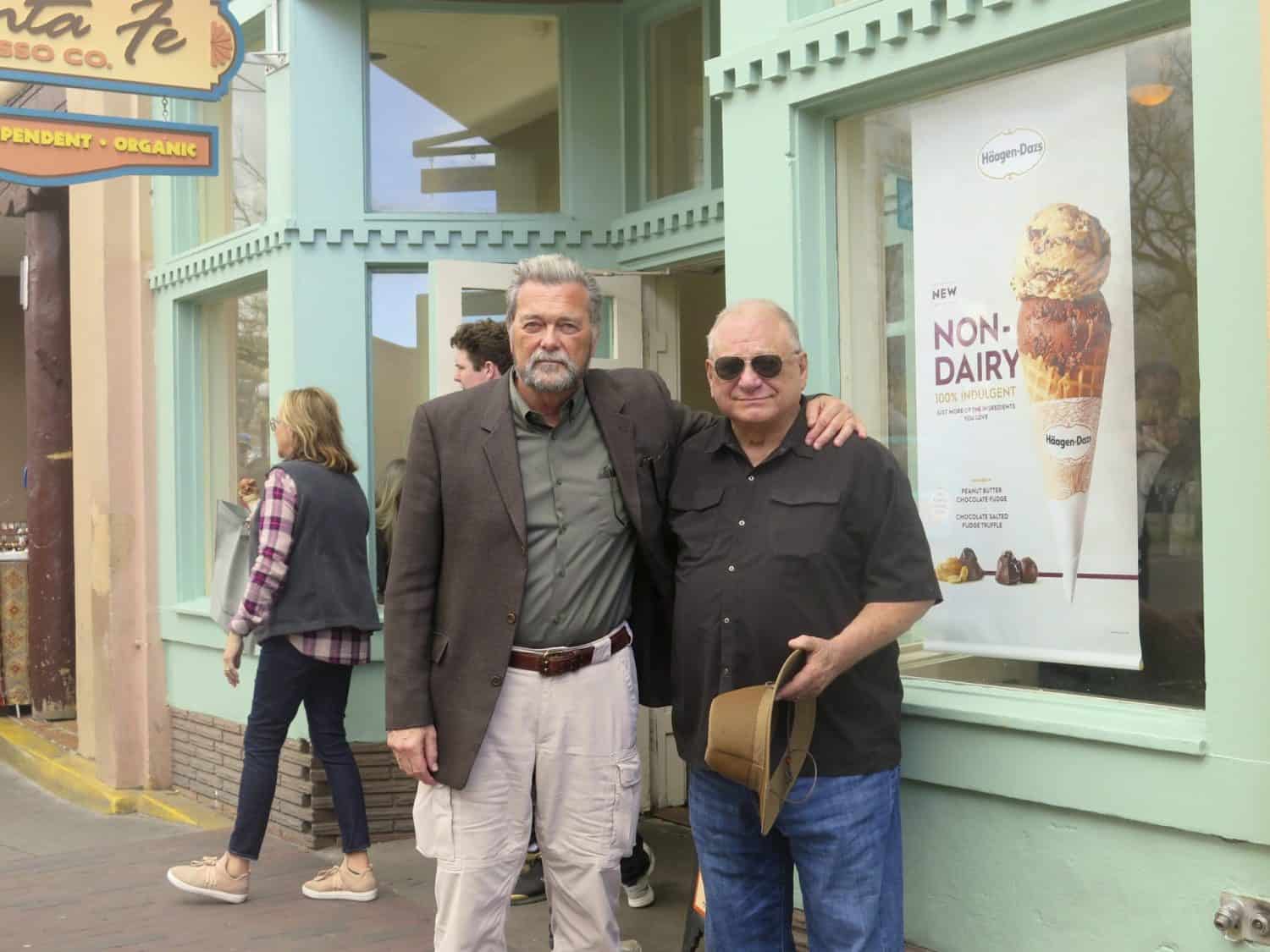
What may have attracted Grigulevich was Zook’s downstairs storage room as a place to live. It had no bathroom, but he could use those upstairs when the pharmacy was closed. The windowless space had a back door to an alcove off Water Street, a block from the bus station. Someone watching Zook’s front door from the plaza couldn’t see the back door on the other side of the block and on a lower level. It was ideal for someone concerned with surveillance. The building, now the Häagen-Dazs Ice Cream Shop, remains similar today. The back door is behind a refrigerated case in the al fresco dining area of a cafe. Since Held’s book came out, retired intelligence operatives have been known to visit the site.
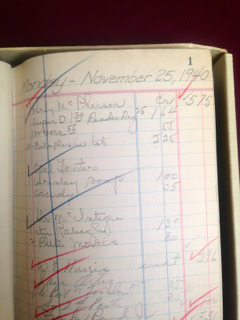
A few years ago, I learned Zook’s business records had been donated to the state History Library. Thinking I might find some evidence of “Rodrigez,” I requested to see them, But when I sat down at one of the library’s large tables, expecting to spend the afternoon going through ledger books and invoices, the first thing I discovered was that everything from Grigulevich’s time was missing. The accession letter said all records from the mid 1930s to November 25, 1940 were destroyed in a fire. To assuage my disappointment, I did a search of the words “Zook” and “fire” in the Santa Fe New Mexican 1938 to 1940. There was nothing about a fire at the drug store, but in a back-page column called “Village Gossip” I read about a trash fire behind the Zook family’s residence on Palace Avenue. It had occurred before April 20, 1940 — a little over a month before Grigulevich would have to be in Mexico.
Sources:
Santa Fe New Mexican back issues, via newspapers.com. (subscription required, but most libraries have access)
A Spy’s Guide to Santa Fe and Albuquerque by E.B. Held, University of New Mexico Press, 2011