
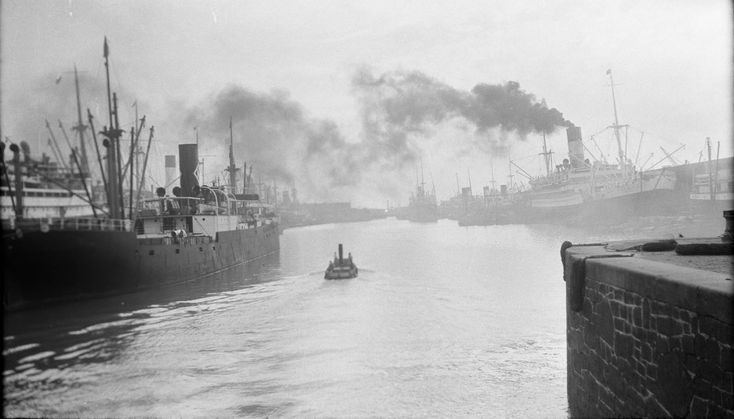

Back in Argentina after December 7, 1941, Grigulevich found himself on the same side as the United States, sabotaging cargo ships bound for Germany.
This was done with Grigulevich’s invention — a Molotov cocktail of sorts. It appeared to be a bottle of wine or cooking oil, but it contained liquids that when mixed would gradually start a fire. With no explosion to alert firefighters or kill anyone, the fire would spread quietly until it was too late to stop.
Its first test was a bookstore in the heart of Buenos Aires, selling books about Germany, its history and literature, as well as Nazi propaganda. The device was slipped into the bookshelves shortly before closing. That evening, the store was engulfed in flames, creating a disturbance that snarled rush-hour traffic the next morning, garnering front-page news that sent a warning to Argentina’s many Nazi sympathizers.
About 150 Grigulevich cocktails were used in Buenos Aires harbor, damaging one large warehouse and 16 ships so severely they could not reach their destinations. As shippers shifted to other South American ports to handle exports of meat, grain and raw materials to Germany, Grigulevich’s network of some 70 agents branched out to Montevideo, Uruguay, and Rio de Janeiro, Brazil.
Crucial to the German war machine were supplies of saltpeter — an ingredient for gunpowder and explosives — mined in southern Chile. It was either shipped out of the Pacific port of Valparaiso, avoiding the U.S.-run Panama Canal and heading through the Straight of Magellan then northeast to Europe, or taken via the trans-Andean railroad to the Atlantic ports. Grigulevich relied on intelligence about these shipments from men who had been involved with the Trotsky raid in Mexico, the brothers Leopoldo and Antonio Pujol, in Santiago, Chile.
Venona cables identifying Grigulevich as Arthur or Artor in South America are spottier than the Vassiliov cables in New York. They skip around, omit passages marked as “unrecoverable” and provide little background or interpretation. The first ones from early 1942 enumerate his traveling expenses between New York and Mexico, and New York and Moscow. The columns of numbers don’t say when the trips were taken, the purpose or what currency is used. However, they substantiate Russian media reports about him as a maritime saboteur.
On May 15, 1942, a note from New York to Moscow mentions “Chilean personalities in Mexico” and complains that Artor “did not report the whereabouts of [Pablo] Neruda.” On July 5, 1942, a note from Grigulevich in Buenos Aires says, “Local ships are no longer sailing to N.Y., but to NEW ORLEANS instead. … I have reliable sailors for this in NEW ORLEANS.”
Cables from 1943 and 1944 concern Grigulevich’s recruitment of sailors and his impressions of them. One was “a promising fellow,” another a “fascist” and another “deceptive.” A cable on June 12, 1943, says his most promising recruit was a Swedish sailor code-named Grisha. A cable on May 19, 1944, says when Grisha was stranded in Tyre, Lebanon, “he secured the position of agent for several firms and will be able upon arrival in Chile to organize his own commercial business without pecuniary support. We think that this plan for the further utilization of GRISHA is the most practical one. Details later.”
A cable from New York on June 15, 1944, says that due to Grisha’s absence, “Arthur” will need to meet with an unnamed source in Montevideo and sets down specific instructions: “On the 4th of each month at 3 o’clock in the afternoon, Arthur will arrive on foot in Calle Juan Carlos Gomes opposite house number 1394. He will be holding the newspaper `La Mañana.’ Our man is sitting on a seat opposite the above-mentioned number and is glancing through the newspaper `El Dia.’ The conversation is begun by ARTHUR.”
Grigulevich became involved with several left-wing publications, recruiting their journalists as spies and even taking part in local communist groups, blatantly breaking taboos against mixing the personal and political with espionage.
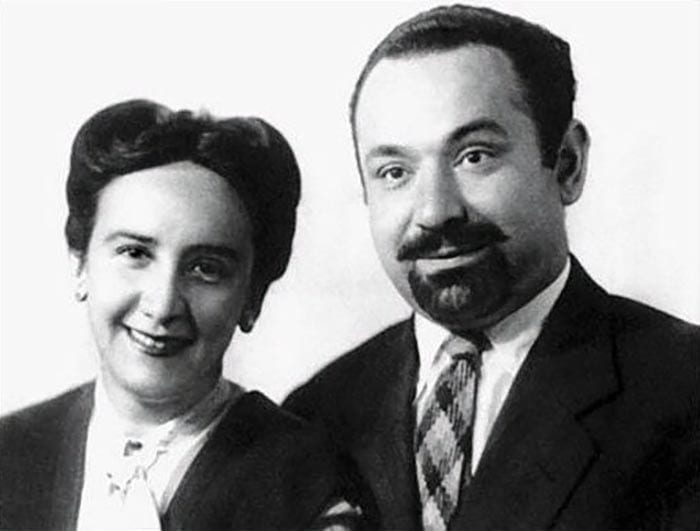
After 1944, Venona cables cease to mention Grigulevich. After the Great Patriotic War ended, Josif and Laura moved to Rio de Janeiro where they operated a bookstore. They welcomed their first child. But the boy died from a heart defect at six months. In their grief, Josif and Laura, now with her own code name of Luisa, began looking for their next assignment.
Sources:
Grigulevich: The Agent with Luck by Nik Nikandrov, Molodaya Gvardia, 2005. Part of a Russian language series called Lives of Remarkable People. Part of Nikandrov’s installment was republished in Spanish by Weibo Ediciones of Chile in April 2025 as El Hombre de Stalin en América Latina.
I should credit writers for English-language Russian-government online journals like Oleg Yegorov of Russia Beyond and Nikolay Shevchenko of Gateway to Russia for their work on the Grigulevich story. Also kudos to Russian writers like Mark Steinberg whose work I have read thanks to Google Translate. It’s no picnic working for the Russian media these days. Historians write wistfully about that brief time in the early 1990s when the Russian intelligence services’ archive was open to them. An eight-part Russian docudrama on Trotsky, released on Russian TV in 2017 and now available with subtitles on Netflix, implies someone was behind his assassination, but never says who.