
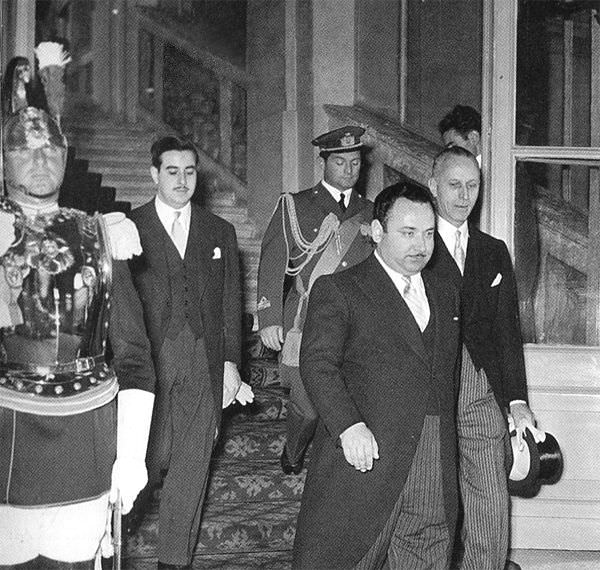
The young couple who showed up in Rome in the late 1940s seemed to know what they were doing.
Teodoro Bonnefil Castro — who signed his name in “the American manner” as Teodoro B. Castro — described himself as the bastard son of a deceased Costa Rican plantation owner from the Alajuela province. He had worked as a grower in several South American countries and recently attended an international coffee exhibition in Lausanne, Switzerland. Now he wanted to make Costa Rican coffee popular in postwar Europe as a way of repaying his homeland.
His wife, known by the lyrical name of Inelia Idalina del Puerto Nieves, was a native of Montevideo, Uruguay. She was described as elegant, intelligent and socially skilled, but also shy, mysterious and with an air of sadness. Through their gifts to the Vatican’s key cardinals, the Castros became conduits for wealthy Latin Americans seeking audiences with Pope Pius XII, still under a cloud in Europe for not condemning Nazi and Fascist atrocities.
Costa Rica had a civil war in 1948 after a disputed presidential election. José Figueres Ferrer, a coffee grower who described himself as a “farmer-socialist,” led the winning faction in 44 days of fighting and became the country’s new president. Upon finishing his first two-year term (there would be two more later), he took a victory lap of Europe and Israel in early 1950. In Rome, he met the Castros who arranged his audience with the pope, By 1951, he had become their partner in businesses exporting Costa Rican coffee and importing petroleum. On Figueres’s recommendation, Castro was appointed as first secretary to the Costa Rican Legation in Rome.
Castro soon wrote to the Costa Rican minister of foreign affairs in a masterclass example of how to get what you want. He began by plucking the heart strings explaining how he and his wife had come to Rome “to see the Holy Father and implore God’s grace and consolation” after the death of their son. Next came the business: A commercial treaty between Costa Rica and Italy would mean coffee could be directly imported, bypassing Swiss, Dutch and English agents who took $10 to $15 fees on each bag of coffee imported to Europe. He saved the best for last: He had paid out of his own pocket all expenses incurred in leasing a former palace in the heart of the city, refurbishing and furnishing it into a new office for the Costa Rican legation at Piazza Sallustio 24. (Today the office of Boeing International Operations.) He ended with flattery by saying this gift was his way of contributing “his grain of sand to the great work that our Superior Government is carrying out.”
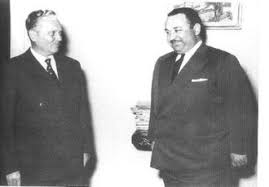
The treaty was ratified before the end of 1951 and a shipping line began direct service between Limón, Costa Rica, and Genoa, Italy. Initially, the Castros lived in one of the three “luxurious halls” in the legation headquarters. But as their business prospered and Teodoro was promoted to “extraordinary envoy and minister plenipotentiary” (essentially ambassador to Italy) in April 1952, the couple moved to one of Rome’s best neighborhoods. Teodoro dressed for success with shined Italian shoes, tailored dark suits and gray silk ties. He was known in diplomatic circles for throwing lavish parties at Rome’s swankiest hotels — where he picked up the tab. He was outspoken in public, defending the Vatican and criticizing communism. Soviet diplomats bristled, not realizing he was working for their side. He became close with the new U.S. ambassador to Italy, Clare Boothe Luce, journalist, playwright, former two-term Republican congresswoman from Connecticut and wife of the owner of Time and Life magazines. Inelia traveled back to Costa Rica by herself to meet with government officials. Teodoro was appointed to represent Costa Rica in Yugoslavia. He traveled to Belgrade (now in Serbia) to meet with Yugoslavia’s leader, Josip “Tito” Broz. By 1953, the Castros were the power couple of European diplomacy.
Then, they disappeared. Teodoro left word with his office in early September that Inelia was ill and that they were headed to Switzerland for a medical procedure. But after a few months with no word from the couple, some newspapers speculated they had been abducted by the Soviets or the Mafia. They would never resurface.
It had all been a ruse. Josif Grigulevich and Laura Araujo Aguilar had successfully used the cover of millionaire capitalists with all expanses paid by the Soviet Union. Laura was not sick, but pregnant. On June 28, 1953, she delivered a daughter they called Romanella after the city of her birth, but formally named Nadezhda on a Soviet birth certificate that said she was born in Russia. Mother and daughter stayed in Switzerland, while Josif headed to Moscow to test the dangerous waters as the Soviet intelligence services were reorganized following the death of Stalin.
Sources:
Unmasked: a true story of charm, intrigue and master spycraft by Marjorie Ross, published in English in 2021 by Cerdas-Ross Industries. Originally published in Spanish in 2004 by Editorial Norma as El secret encanto de la KGB: las 5 vidas de Jósif Griguliévich. Ross is a well-known food writer in Costa Rica who learned about Grigulevich as Teodoro B. Castro while her husband was in the Costa Rican legation to Rome. In an effort to shield her husband, she wrote the book like a novel without attribution — what she described as “new journalism.” Not only was this a major scoop. Much of it is substantiated via other sources.