
The main casualty of the Trotsky raid was the gatekeeper. Robert Sheldon Harte, a 25-year-old New Yorker, had signed on as Trotsky’s bodyguard a few months earlier. He opened the gate because he knew the man on the other side — Josif Grigulevich.
Harte’s motivation isn’t clear, but it was likely ideological. He left with the raiders, so it looked like he was allied with them. But then he became angry and threatened to expose the raiders and specifically Grigulevich. His body was found a month later, buried in the dirt floor of a kitchen in a house rented by the raiders. The autopsy and blood stains indicated he was shot twice in the head as he slept on a cot.
Police looked into reports that a “Jewish type” with a French accent planned and financed the raid. Grigulevich left Mexico quickly with Laura Araujo Aguilar on Chilean passports supplied by the Chilean consul general in Mexico City, Pablo Neruda, who would become famous for his poetry. One account has them heading north into the United States, crossing the border at California and making their way back to Santa Fe. This would have given him opportunities to participate in the reorganization at Capital Pharmacy and to dispose of any other evidence of his presence in Santa Fe. That would explain why the first entry in the Zook’s ledger after a gap of years is from November 25, 1940 — seven months after the trash fire. Josif and Laura eventually got back to Argentina via a circuitous route.
After the May 24, 1940, raid, David Siqueiros and his wife Angélica Arenal drove to Cuernavaca, stayed at the home of friends and followed news reports a bout the raid. After the police named Siqueiros as the prime suspect, they headed to the mountainous backcountry of Jalisco. They dressed like locals and used aliases (he was Macario Sierra, she was Eusebita) though many recognized him as an organizer for the miners union. They stayed in different houses, rode horses and sometimes camped out.
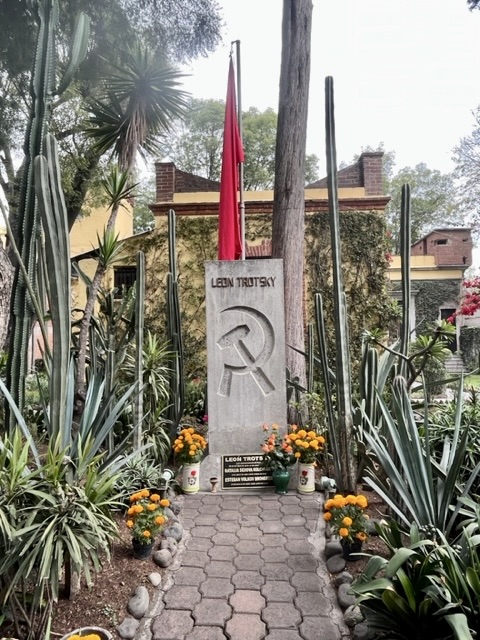
On August 20, 1940, another Stalin agent plunged a pick axe or piolet into the top of Trotsky’s head as he read an article his assassin had written. Ramón Mercader was a Spanish NKVD agent with two fake identities, Belgian Jacques Monnard and Canadian Frank Jacson. He knew Griegulevich from the Spanish Civil War. He was the son of Caridad Hernandez Mercader, a Catalonian communist and the lover of Naum Eitingon, chief of Operation Duck, the code name for the two-prong effort to kill Trotsky. The couple quickly left for Europe.
“They made me do it,” Mercader screamed when Trotsky’s guards apprehended him.. “Kill me! Kill me! I don’t deserve to live.” An ambulance took Trotsky to a hospital where he died the next day at age 60. During his 20 years in a Mexican prison, “Jacson” didn’t divulge his real name. Upon release in 1960, he went to Moscow where he got a pension and was declared a hero “for the special deed.” He spent his last years in Cuba.
One morning in October 1940, when Angelica was away, Siqueiros was awakened by a shout of “Surrender, hijo de la chingada.” Soldiers had surrounded him. They took his weapons, tied his arms behind his back, put a noose around his neck and marched him down the mountainside. Siqueiros thought they might kill him. But when they got to the colonel in charge, the mood changed. The colonel said that although he must take him to jail, he would be treated with respect due a hero of the revolution. Back at the village, the caravan was greeted with cheers of “Viva Siqiueiros.” The mayor had arranged a banquet. Siqueiros sat at the head table with the colonel and praised the soldiers for their cleverness in finding him. “This could only have happened in Mexico,” he would later write.
Back to Mexico City, Siqueiros was jailed on charges of murdering Harte, attempting to murder Trotsky, impersonating an army officer, stealing police uniforms and two cars, firing automatic weapons, criminal conspiracy and fleeing the law. He stayed in jail six months where he met with supporters and was interviewed for articles. After the most serious charges were dropped, a judge released him on bail. On the day of release, he was escorted to a limousine that took him to the president’s residence.
President Manuel Ávila Camacho, who who had won in a landslide over Rivera’s candidate, told Siqueiros he could go free if he left immediately, jumping bail and going to Chile where he would get asylum and a contract for a new mural. Ávila wanted to avoid violence. Neruda had made the arrangements. Siqueiros had hoped for a show trial, but now that Trotsky was dead, it was moot. So he accepted exile. On April 28, 1941, he, Angélica and her daughter, Adriana, 8, left Mexico. Siqueiros would not return for years.
Sources:
Siqueiros: His Life and Works by Philip Stein, published in 1994 by International Publishers Inc., New York
Discussions with Siqueiros’ great nephew Robert Siqueiros in Santa Fe. He grew up in El Paso where his father owned radio stations.