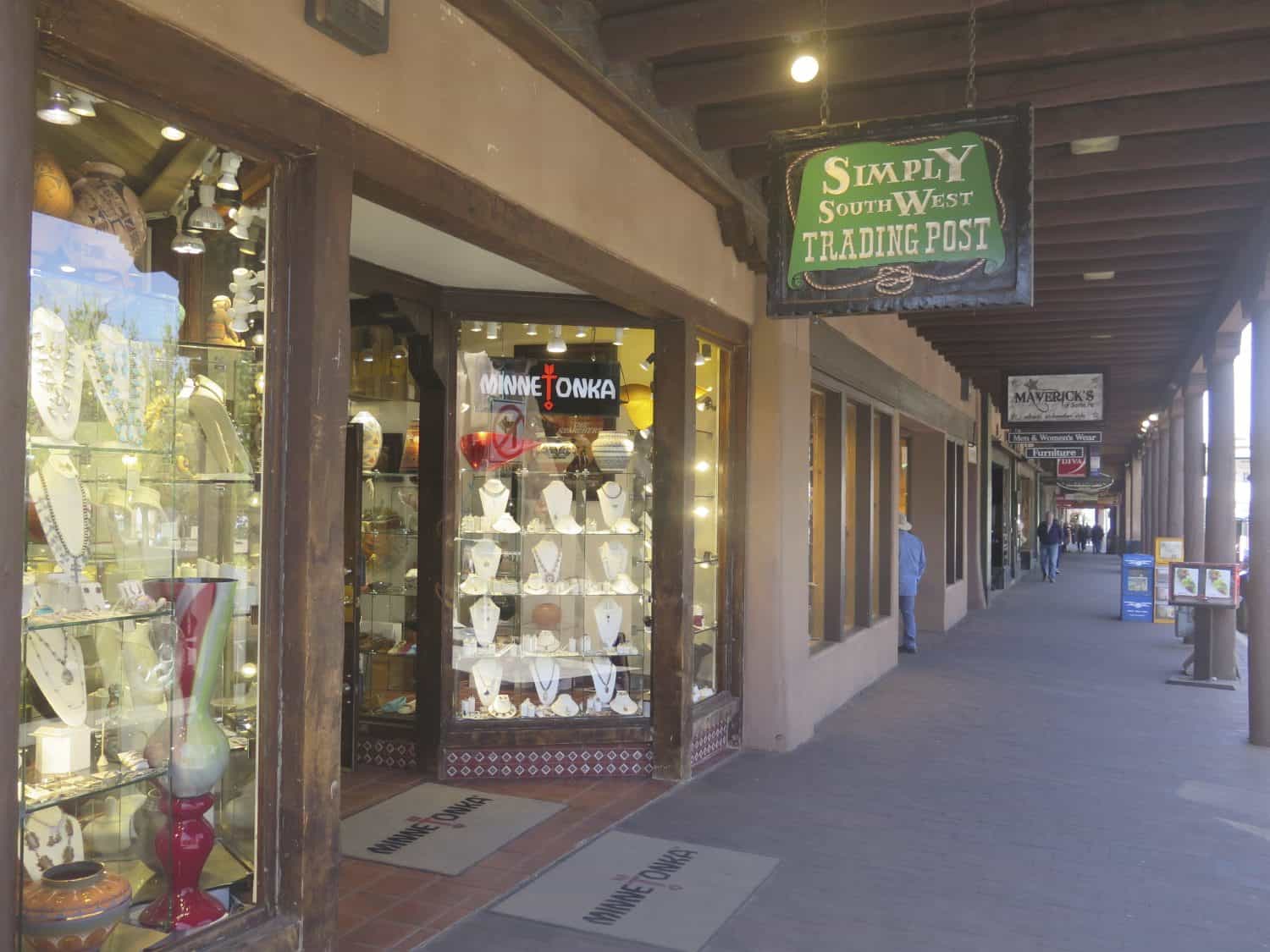
Zook’s wasn’t the only drug store Grigulevich got to know in Santa Fe. Eight doors away was Capital Pharmacy, 82 East San Francisco (now the Maya Gallery), with colorful wooden statues at its entrance, and inside a soda fountain, juke box and a wide assortment of merchandise including curios for tourists.
Owner-pharmacists Martin Gardesky and Morris Yashvin were, like Grigulevich, secular Jews who spoke Spanish, had traveled extensively in Latin America and were interested in history. On one of Gardesky’s trips to Mexico City, he found and purchased a copy of a report from a Spanish governor of New Mexico about the 1680 Pueblo Revolt and donated it to the New Mexico Archives where it remains today. Gardesky and Yashvin may have influenced Griegulech to begin identifying himself as a historian. It would explain his trips to Mexico.
Under Gardesky and Yashvin, Capital Pharmacy became a teenage hangout, a forerunner of the iconic ‘50s malt shop. In 1930, it figured in the life of the future Beat writer and hard-drug connoisseur William Burroughs. According to an online article, no longer accessible, by James Reich, when Burroughs was a 16-year-old student at the Los Alamos Ranch School for Boys, he spent a night away with his mother at La Fonda. At the nearby “Capitol” (sic) pharmacy, he managed to buy enough of the sedative chloral hydrate to overdose back at his room at the school. After he recovered, he was expelled.
Capital and Zook’s both were established around 1909, long before Grigulevch’s time, so he couldn’t have “opened” either, as his spymaster claimed. But he may have been involved in a reorganization at Capital. On December, 14, 1940, Gardesky died after a four-month illness. Yashvin, Gardesky’s widow Florence Spitz, and silent partner Carl Bishop searched for a new managing partner. A footnote in a biography of Tina Modotti, an associate of the leftwing artists in Mexico and frenemy of Frida Kahlo, says Grigulevich claimed to have returned to New Mexico after his assignment in Mexico. The spymaster said Griguevich did not turn over the drug store to his agent until 1941.
Freeman Fraser, who had known Yasvin in Denver and was already was one of Capital’s directors, became the new managing partner. Fraser eventually left to start Free-Fraser Pharmacy. He died in 1963, but the subsequent owners kept the name. When Free-Fraser went out of business in 2010, the last owner told the Santa Fe New Mexican that the founder was named Gordon Freeman, not Fraser.
I do not mean to disparage the reputations of Fraser/Freeman, Morris Yashvin or Katy Zook. But when Grigulevich told his boss he was developing his own agents, they are probably who he was thinking of. Recruiting new spies in New Mexico would put him in good stead in Moscow. But I doubt his Santa Fe friends knew he was a spy, much less that he was recruiting them to be spies. I think they were just kind to him and he figured he could count on them. Like many other Americans, they hoped communism would improve life in Russia. Yashvin had Russian ancestry. He was born in Kansas City, Mo., but seemed “foreign” to some who joked he was a spy. Nevertheless, he was well liked in Santa Fe. When he ran for mayor in 1962 as a Democrat, he lost only narrowly to Republican Pat Hollis, 4,518 to 4,331, with 174 for the independent, artist Tommy Macaione. As for Katy Zook, she took over the pharmacy after her parents died and continued to run it until she sold it in 1965. She was known around town for her little dog Tillie, her red convertible and for winning bridge tournaments. She got to travel some. But she never married.
Perhaps the entire story about the pharmacy/safe house is false. The initial spymaster memoir and its sequel were criticized by espionage scholars like John Earl Haynes and Harvey Klehr for demonstrating “how faulty memories, Soviet intelligence agency disinformation, sloppy citations, misplaced trust in documents provided by unidentified sources under unexplained circumstances and egregious lapses in logic and judgment can lead to conclusions unsupported by evidence.”
Soviet cables have the code names of known Manhattan Project spies like Theodor Hall, Klaus Fuchs and David Greenglass (brother of Ethel Rosenberg) and couriers like Harry Gold, Lona Cohen and Saville Sax, but they never mention a drug store/safe house in Santa Fe. Why would Gold travel from New York to New Mexico twice in 1945 to gather a few pieces of paper from Fuchs and Greenglass if there was a dead drop in Santa Fe?
Sources:
Sacred Secrets: How Soviet Intelligence Operation Changed American History by Jerrod and Leona Schecter, Brassey’s Inc. 2002.
Tina Modotti: Between Art and Revolution by Letizia Argenteri. Yale University Press, 2003.
Correspondence to Los Alamos historian Ellen Bradbury from people familiar with Capital Pharmacy and its principals.