
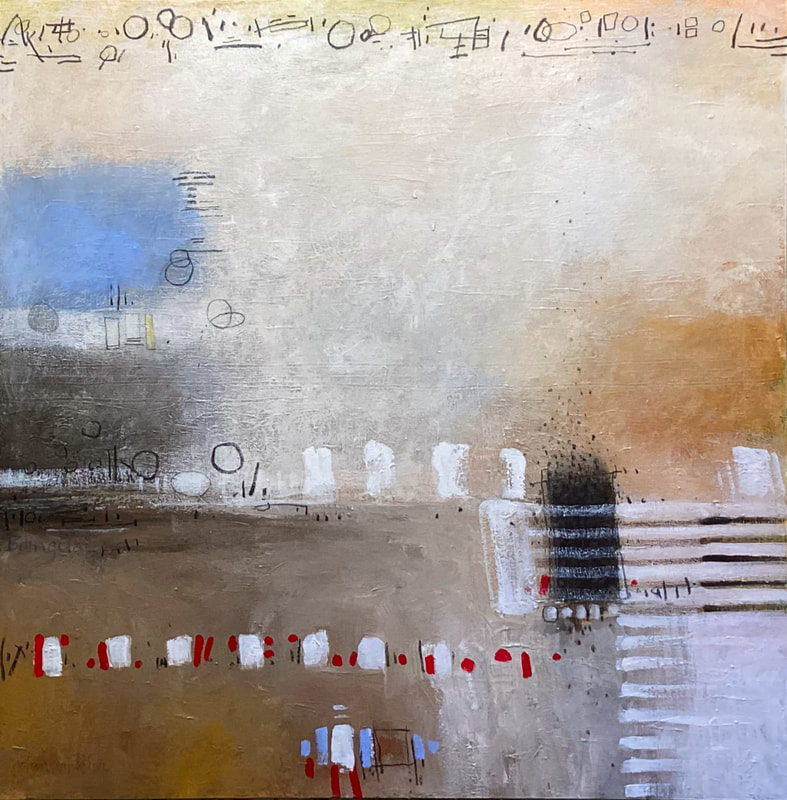

Maybe she had to suffer. She lost her husband about six years ago. Or maybe her last 10,000 hours of making art put her over the top–on top of the preceding lifetime of “doing” art and “being” an artist. It may also be that she learned more about “letting go” and “letting in” higher powers.
Whatever it is, Nolan Winkler has leveled up, which in turn pushes the viewers’ perception to a higher level.
I’ve admired and watched Nolan Winkler for 20 years, while recognizing that my sensibility and hers were different, but now she’s bound to encompass most sensibilities, her work reaching universal appeal
Let me explain. My sensibility is “classical” and Nolan’s was “romantic,” but now she’s both.
Classical art is self-contained and collected. It depicts calm and considered moments. No high drama. Schools of thought, refinement and contemplation that gets to the essence of something, to a universal truth or an ideal form. A humanitarian and philosophical engagement with the viewer that makes us feel the balance and beauty of the world and our place and part in it.
Romantic art seeks the viewers’ emotional jugular–an individual artist laying his or her guts out–agony or ecstasy or both at once. Authentic emotion with no mediator between artist and viewer.
Years ago Nolan Winkler told me she listens to music while she works and I asked her “what kind?” She named a blues singer who wailed and trilled–a “gut-bucket” singer who made you feel alive–each existential moment.
I’m more thinker than feeler, so what I admired most about Nolan Winkler’s art was her draftsmanship. I still do, but now her thousands of hours of art gestures and existential moments capture classical stillness and romantic crescendo.
The compositions coalesce into a musical fugue. But the composition is so natural it almost eradicates the (romantic) artist’s hand behind the placements and touch.
And they are active, like watching a dust devil stir up leaves and flotsam and having just now settled into a pattern, making the viewer part of the process, making them watch and still themselves until the painting coalesces into rightness.
It’s very hard to capture the moment of coalescence, but she does it over and over again in these new works.
I love the light-handedness of her paintings, the lack of drawing attention to her masterful draftsmanship. If she chose to, she could slay and awe the average viewer by doing a single flower or portrait, showing off her ability to faithfully capture and render people or things.
And she paints with the speed and efficiency of Manet–no middle tones, perfect one-touch placement of brushstrokes or lines that define the edge of the object, anchoring it in space, as well as the space it takes up–the stroke doing double duty as outline and volume.
But Nolan Winkler has never been a specialist. She’s an exquisite draftsman, colorist and texturist. Her “latest works” at Rio Bravo are complex. She’s always incorporated writing into her painting, but now her semiotics are more developed and abstract and multi-functional. The symbols and marks are utterances and musical scoring and kicks and rhythms that skitter and enliven our language, visual, haptic and musical centers.
Perhaps she was always composing, not just creating still visual compositions, but now her art triggers synesthesia in the viewer as never before, making us more sensitive and perceptive as she reaches and grows as an artist.
I think Nolan Winkler’s widowhood and aloneness may have forced her spirit and art into a larger, more universal container, making these latest works numinous. There is a saying–Break my heart, God, so that I may know You better.
Her new works went up at Rio Bravo Fine Arts on August 31 and will remain until Oct. 25. The art opening will be Saturday, Sept. 12, during the monthly Art Hop, from 6 p.m. to 9 p.m.
Kathleen, you are a writing wizard on art and I thank you for this review of my latest exhibit. I just had a dinner party where I told my guests, when asked about the show, that I thought it my best in years. It is always such a pleasure to see a lot of my work at once and I admit I was impressed with my output. My other favorite exhibit, years ago, was another where you praised the work and your review got into the old THE magazine. I was thrilled then and am once again thrilled with your work. A sincere thank you for taking the time.
Wonderful article! I wish I could see the exhibition.