
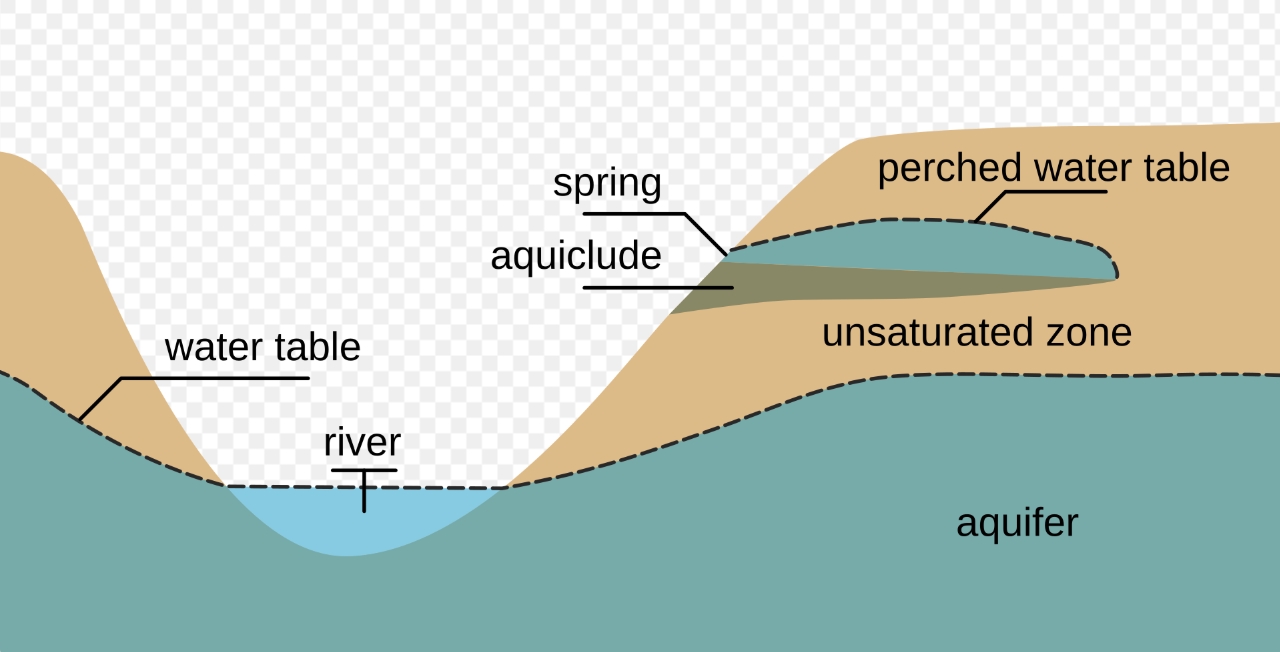

Do you know the word phreatic (accent the “a”)? It comes from the Greek word meaning “spring” or “well.” Hydrologists use it in the phrase “phreatic zone” to refer to what we loosely call the “aquifer.” The phreatic zone is the saturated soil into which our wells reach to access groundwater and is distinct from the “vadose zone,” the unsaturated soil above the phreatic zone where plants normally get their water. The top surface of the phreatic zone is called the “phreatic surface,” which we generally think of as the water table.
If you live in New Mexico, where most towns and villages are on streams (because that’s were the water is in the desert), you should know this word and what it means in relation to your life, because water is life. That means if you live in Chloride, Winston, Kingston, Hillsboro, Arrey, Monticello, Cuchillo, Elephant Butte, Williamsburg, Truth or Consequences, etc., how the phreatic zone behaves in relation to the stream dictates whether you have drinking water or not. Take a closer look at the image above.
Normally, by definition, the phreatic surface meets the flowing stream’s surface. Since the aquifer in the hills rises above the stream, groundwater is pushed into the stream. The stream is said to be a “gaining stream.” But we all know that here streams often go dry. That is because so much water is taken out of the phreatic zone the stream flow isn’t enough to compensate what is taken out. That happens around here seasonally when rains and snowmelt are insufficient to offset what is taken out. Then, we have a “losing stream.” And most our streams, depending on the situation and the location are both losing and gaining at different times and in different places. That is an intermittent or ephemeral stream, which is the case for most of us. For a more detailed look, see https://books.gw-project.org/groundwater-in-our-water-cycle/chapter/groundwater-connection-with-streams/.
So, what is being “taken out” of the phreatic zone? Take a look again at the illustration. Because the phreatic surface normally is at the same level as the stream, the aquifer is very shallow near the stream. That means we only need to dig very little to get to the phreatic surface: thus the old shallow dug wells we all know. But much of what we take out is returned in the form of waste water and septic systems. Though there is a time delay that is significant, our domestic water use doesn’t threaten the phreatic zone that much. Something else is taking water out of the phreatic zone without any return.
Normally, plants root in the vadose zone. But here our trees are able to root directly in the saturated soil of the phreatic zone next to streams without rotting away. Arizona sycamore, cottonwood, desert willow, salt cedar, Arizona black walnut, mesquite are phreatophytes. Yes, it is the same word. The ending -phyte comes from an ancient Greek word meaning “to bring forth” or “growing.” Here is what Google’s AI says about the word: https://www.google.com/search?sca_esv=678aa669decbf740&sxsrf=ANbL-n6jNF8oj0jao4qiHBUisn5oZF4T0Q%3A1777037712453&q=phreatophyte+meaning&oq=phreatophyte&aqs=heirloom-srp.1.0l5.
Phreatophytes grow in the phreatic zone: they are water loving, water living plants, adapted to desert existence not just by being able to root directly in water saturated soil, but by growing extensive and deep root systems to find that water when the stream does not provide sufficient water. They are super efficient at sucking water out of the ground. They are wetland species that have adapted not so much to the desert as to the intermittency of desert streams.
When humans started digging shallow wells near streams, we started depriving the phreatophytes of their balanced existence with groundwater (a lag-time problem). They were bound to start dying back. But the changing ecology is so slow, it was hardly noticeable. Much of our used water is returned to the soil; so, the competitive rebalancing takes some time.
Once the die back is noticed, however, environmentally minded people want to plant new trees. This was just done in Hillsboro this week where some twenty five cottonwood, sycamore, desert willow, and scrub oak trees were planted. Unfortunately, this will not benefit the local phreatic zone but simply reduce the available groundwater for humans, existing trees, and also creek flow – all of which the plantings intend to help but won’t.
These species are often recommended as environmentally friendly plantings in arid regions. They are advertised as “water conserving” and adapted to the desert clime. Both are true. But their truth demonstrates precisely why they should not be planted in our riparian locations. Their adaptation means they are phreatophytes which have evolved mechanisms of extracting enormous amounts of water from very dry soil (extensive and deep root systems – the mesquite can extend roots out 150 feet or more) or evolved structures for extracting and storing enormous amounts of water for the long seasonal periods without precipitation (the desert willow’s tap roots, the non-phreatophyte scrub oak’s rhizomes and tubers), or evolved forms for extracting and evaporating huge amounts of water as protection against the heat (the numerous, quaking leaves of the cottonwood).
When people say that these trees conserve water, they mean that since these trees do not need much watering, we don’t have to turn on the tap for them so often. But our drinking water comes from the phreatic zone, and these trees are adept and adapted at sucking it up. A mature cottonwood uses, that is, evaporates, between 100 and 200 gallons a day, much more than a conservation minded family uses since it returns much of the used water back to the soil. A monstrous cottonwood can suck up and evaporated 300 gallons a day. They do not need much watering because they get the water themselves.
If you live in Los Angeles and your drinking water comes from Owens Valley, planting a “water conserving” plant might save using imported water, but for well water users it simply increases the competition. Essentially, these trees are pumps drawing water from the local phreatic zone and evaporating it into the air to fall as rain in the Midwest. As long as they are growing around us, we can learn to live with them, respect them, love them, enjoy them, protect them, but to try actively to increase their numbers in riparian corridors is self-defeating unless some person is willing to give up water entirely to support every new tree (or, more reasonably, to stop using an evaporative cooler since a full-house cooler evaporates about the same amount a day as a cottonwood tree; we need not even consider air conditioning which runs on electricity generated mainly by boiling away water unless you have solar or wind).
We are going into two water crises at the same time: global warming (we are experiencing the driest two decades since 800 AD and continuing at this moment in extreme drought) and the settlement of the Texas suit against our overuse. See https://sierracountycitizen.org/what-you-need-to-know-march-22-2026-climate-change-overuse-send-the-middle-rio-grande-into-dire-situation/ for the first and https://sierracountycitizen.org/what-you-need-to-know-march-4-2024-water-in-sierra-county/ for the second. We need to reduce drastically our depletion of groundwater to have a reasonable chance for normal living in southern New Mexico in the next hundred years. Planting phreatophytes in the shallow aquifers will hinder that chance, even if the effect of those plantings will not be apparent for years to come.
When I first came to Hillsboro, the Percha ran all year. Then it was seasonal. Only a few years ago, there were still seeps, keeping a bed of watercress alive just above the bridge. Now even that is gone, and gone, too, is the wildlife that that small stretch of water supported. Unlike us humans, the deer cannot dig into the phreatic zone no matter how shallow the phreatic surface. Their lives are as ephemeral as the stream. Streams and their riparian woods are rare and wonderful contrasts to the desert land. We should not be diminishing them in a misguided effort to green the red desert.
I ran out of irrigation water last June. Amazed we have surface water this spring. I may need to drill my domestic water well deeper come Aug. This wind dryer us out of the green we had. I read the Butte will be lowered to 2%. That is pretty low! Do our rain dances!
Hi, Eric,
I’m sorry to hear of your water problems. As you must know, you are not alone along Animas Creek who has that difficulty. I’ve heard the same from all along downstream. How deep was the irrigation well you were using that went dry last year? I only remember your domestic well and the wonderful dugout well. What’s the situation with the dug well? Can you see water in it?