

The Village of Williamsburg Infrastructure Capital Improvements Program over several years has made repaving streets their top priority and this year is no different. Three of the top five projects are street repavement projects.
The ICIP is a list of capital projects each local governmental entity must turn into the state by July 12 this year. The projects span five years and the list must be updated each year. This year’s ICIP spans 2028 to 2032.
The state legislators request that the local governing bodies clarify what their top five projects are so they can in turn prioritize how they will disburse their capital outlay money.
Members of the House of Representatives get about half a million a year in capital outlay and senators get about twice that. The governor has a much bigger pot of capital outlay money to disburse each year.
That’s not much money to spread over the many thousands of people they represent, but capital outlay grants don’t come with strings, oversight, match and loan requirements.
So the top five projects are the focus of local officials’ lobbying efforts, directed at their geographic state representatives and Governor Michelle Lujan Grisham, as well as toward New Mexico’s U. S. Congress members.
State and federal agency grants and loans also require that any application for capital project funding be included on the current ICIP list, but whether the project is in the top five doesn’t matter. The vetting process is not political. What’s determinative is usually a preliminary engineering report, the entity’s yearly audit and its ability to pay off a loan and come up with a cash match. Projects that benefit a larger portion of the community and address a critical need are favored as well. Funding for pools and golf courses, not so much. Funding for electric facilities that should be self-sustaining if their fees are in line, not so much.
The ICIP is therefore very, very important. It largely determines a community’s future, functionality and appearance. It also has a direct effect on how much you pay for utilities, gross receipts taxes and property taxes year after year and up to 40 years in loan payoffs.
The Village of Williamsburg, as required, had at least one public hearing on its ICIP, which was 3:30 pm to 4 pm May 14. I was the only person from the public. My major concern was that the Village coordinate with T or C to have its road projects coincide with the city’s waterline replacement to save the people from expensive underground boring and relining of pipes or double tear up of streets. I also asked Trustees to stop allowing street design that rushes polluted stormwater into the river, as addressed in this article: https://sierracountycitizen.org/village-of-williamsburg-needs-to-plan-with-t-or-c-on-icip-road-and-water-projects/
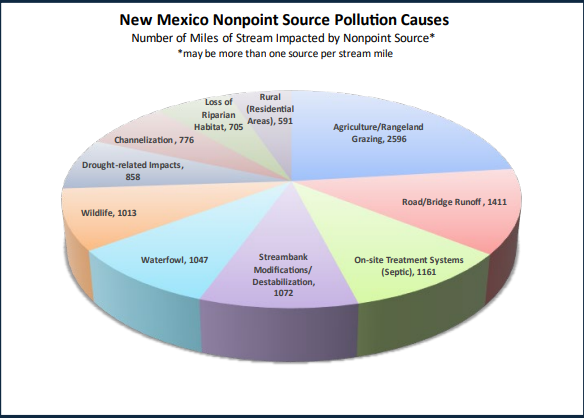
According to the EPA and New Mexico Water Quality and Surface Water Quality bureaus, runoff from streets is a major cause of water pollution. Runoff from streets is rich with microplastics from tire wear, polycyclic aromatic hydrocarbons from oil and fuel and heavy metals–copper, zinc and lead–from brake pad wear.
Fifty percent of New Mexico’s streams and rivers do not meet Clean Water Act standards.
First Mayor Deb Stubblefield enlightened me as to why the Village can’t coordinate with T or C.
Although T or C owns the water pipes in the Village and Villagers pay T or C water utility bills, the Village was not included in T or C’s 2019 water engineering study, which is what has and will dictate T or C water projects over many years. Stubblefield was rebuffed when she asked the city in 2019 why the Village was not included. The city manager at the time was Morris Madrid.
The Village can’t wait that long to address its roads, Stubblefield said, which is the number one complaint among its citizens.
For each of the road projects, Stubblefield said, the state of the water pipe is examined, and if it needs replacing, then it is replaced. So far only a pipe under Veater Street qualified, and current City Manager Gary Whitehead went to the scene and agreed. It was done on the city’s dime. Hopefully this cooperative, on-the-spot agreement will continue, but it’s not formalized.
Stubblefield said the Village is “landlocked” and owns no land that it can build on. The only thing it owns, she said, are the roads and sewer. The sewer pipes have been relined and the two lift stations replaced just recently, leaving the roads as a focus, she said.
Stubblefield and Village Clerk Amanda Cardona addressed my concern that the river is being polluted. The streets have and will be designed by Wilson & Company, the Village’s under-contract engineering firm. The sidewalk, curb and gutter are designed to channel and speed stormwater runoff into the river instead of capturing it in greenways and swales.
Stubblefield said residents are concerned with their land being flooded, not with capturing stormwater, the greening of the Village or the pollution of the river. And where would these greenways be located?
Cardona confirmed that what residents want is for stormwater to be quickly directed to the river during monsoon rains, recalling the damage from the July 2020 five-inch-rain that fell in an hour.
Stubblefield said, “we are trying,” citing one instance in which a perforated or French drain was put in front of one property on Mona Avenue that allows the stormwater to go “into the ground” instead of to the river. She agreed to ask Wilson & Company to consider incorporating “green infrastructure” into future street designs.
I pointed out that the Village may have no choice in the near future, that the EPA and NMED, after the Trump Administration is out of power, will likely reinstate enforcement of the Clean Water Act. The Village doesn’t want to pay for retrofitting of its stormwater runoff methods–always much more expensive–instead of following nonsource pollution prevention practices now.
The Village Trustees voted to make the following projects their top five on the ICIP, three of which are street repaving projects:
- Hyde Street repavement
- Mud Springs Dam and Channel 800 maintenance: spalling, cracks, vegetation removal and erosion control.
- First Street repaving, including addressing stormwater runoff containing rocks and sediment resulting from NMDOT’s work to Exit 75, which blocked off the north end of First Street with rocks and dirt.
- Central Avenue repaving
- Vault toilet for Stage Coach Park, as well as adult exercise equipment
No cost estimates were given by Cardona or trustees for these projects. Although state submission requires such estimates, they approved the ICIP resolution formally, evidently leaving it up to Cardona to determine the cost and not letting the public know how much of their money will possibly be expended.