

The New Mexico Environment Department will issue the Copper Flat Mine a wastewater discharge permit without a public hearing unless we ask for one.
Send a request for a public hearing to jordan.anderson@env.nm.gov and make sure to give a reason why you are concerned about the permit related to wastewater discharge.
Please find a link to the draft permit here: cloud.env.nm.gov/resources/_translator.php/YmE1ODUzYTgzYzVmOWUyYmUzNTRjOTUwY18yNDE4NTc~.pdf
It is a very complicated and yet vague draft permit, at least to me.
For example, it doesn’t mention the 1,100 acre feet a year of water right the Copper Flat Mine has been awarded by the Office of the State Engineer and where the four production wells and dozen or so other wells are located and piped and how they fit into the mining processes.
It doesn’t give an estimate of how much stormwater and “dewatering” water will be collected and used in the mining processes. This is water unpermitted by the Office of the State Engineer.
Just like the Mining and Minerals Division’s draft permit, the Office of State Engineer has not been consulted or weighed in on this wastewater discharge permit.
The discharge permit would allow Copper Flat to “discharge” 4.95 acre feet of water a day that is “entrained” or trapped in 38,000 tons a day of “dry tailing.” The dry tailing is crushed ore that has all but 15 percent of moisture squeezed out of it after going through flotation methods used to separate copper, molybdenum and gold from it.
Imagine an eight story apartment building that takes up a quarter block. That’s equivalent to 38,000 tons a day of ore.
Imagine one-gallon milk cartons stacked on top of each other 250 miles up (50 miles up is the edge of space.) That’s the equivalent of 4.95 acre feet a day or 1,613,000 gallons per day being “discharged” in the “dry” tailings.
The discharge permit would also allow 69.188 acre feet a day of “dewatering process water” to be piped to the “process water tank.”
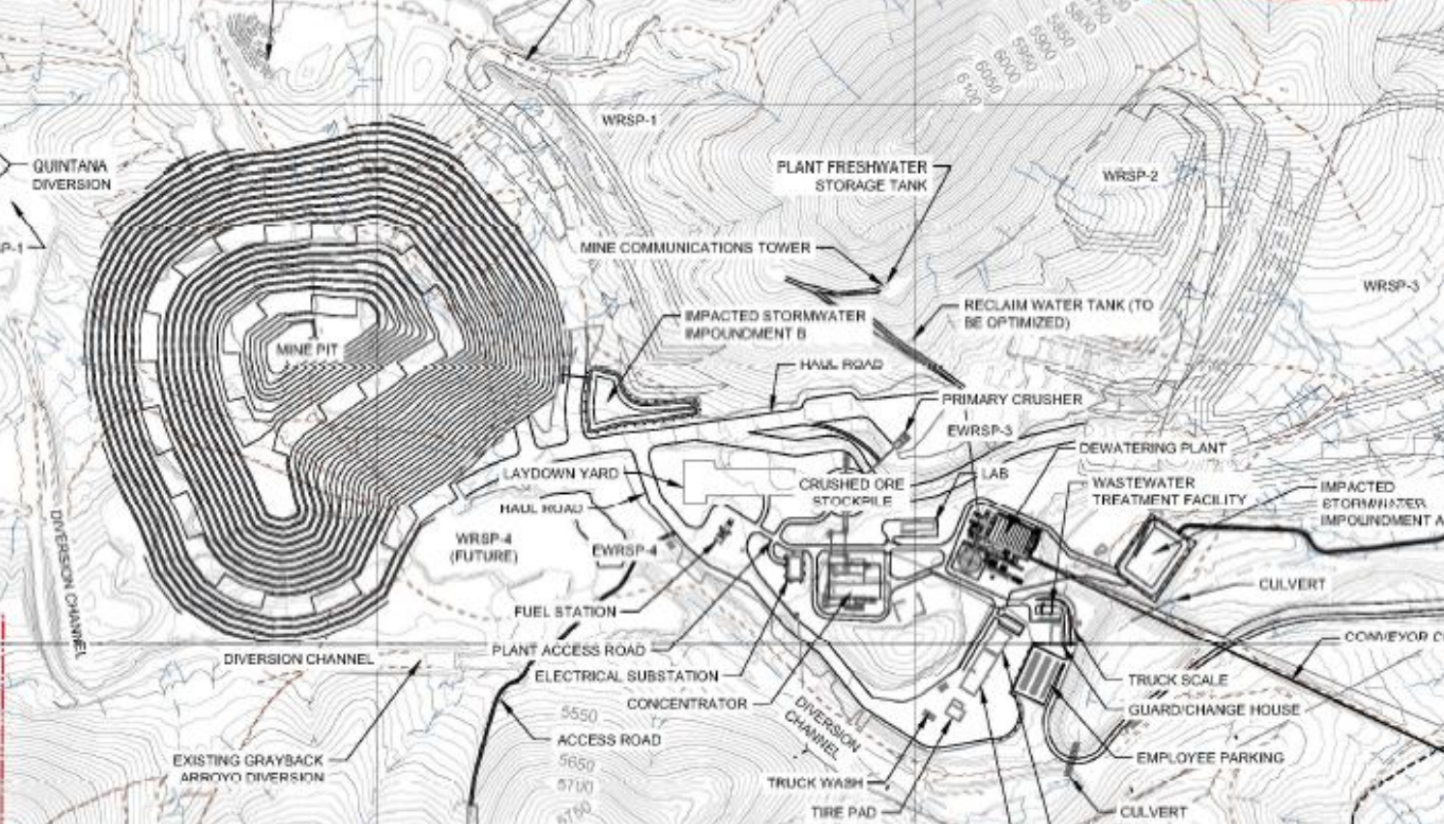
This is water from the “Open Pit Surface Drainage Area” that is 161 acres and which will eventually be about 900 feet deep. Water will naturally drain into it because the ground water is at seven to 156 feet deep, according to page 13 of the draft permit.
If you add 4.95 acre feet and 69.188 acre feet that’s 74.138 acre feet a day of water discharge. Since most mines operated 365 days a year, that comes to 27,060.37 acre feet of water a year. Of course the water will be reused over and over again.
But since no analysis of water use from water right or dewatering or storm water and their relative quantities is given, reuse is impossible to figure.
Seems like a helluva lot of water, much of it coming from “dewatering,” which is intercepting and taking publicly owned water with no water right. Why isn’t the OSE being consulted or sticking its nose in, wanted or unwanted? The OSE should be concerned, since it must reduce groundwater pumping by 18,200 acre feet annually in the Lower Rio Grande Water Basin–the same basin as Copper Flat Mine.
The other big concern is “Acid Rock Drainage.” The draft permit states the “open pit walls, waste rock stockpiles and the dry stack tailings facility and other disturbed areas may contain sulfide minerals that when oxidized [exposed to air] generate acidic solutions that produced ARD or Acid Rock Drainage that may exceed water quality standards. . .”
I added up the footprint acreage of acid-producing areas and it comes to 952 acres. But many more acres are not, but should be calculated that will be potential air and water pollution sources.
The open pit drainage area is 161 acres, but it will eventually be an inverted hill 900 feet deep–a cone whose rim is half a mile wide at 12:00 to 6:00 and 3:00 to 9:00.
Then there is the Dry Stack Tailings Storage Facility. It will have a foot print of 500 acres, but will also be an inverted irregular terraced mountain with thousands of acres of potential acid producing air and water pollution.
There will be mini mountains of “waste rock stockpiles.” Three new ones will be produced over the 11-year estimated mining operation with footprints of 40-, 49- and 122 acres. Who knows how high they will be.
There were five mini mountains of waste rock that were left by Quintana, which mined for a mere three and a half months in 1983. It makes one cynical about the NMED and MMD permitting processes that these piles were not “reclaimed” or covered in dirt with vegetation grown on top to prevent “oxidation.” Copper Flat is supposed to do the reclaiming eventually. They have a footprint of 16-, 10-, 11-, 20- and 23-acres.
All told, that’s 952 footprint-acres of potential air and water pollution.
In summary, you may want to ask for a public hearing in order to ask questions and express concerns about the enormous water right and groundwater intercept use and their pollution factor after multiple reuse that is being discharged. Since the wastewater discharge permit also covers Acid Rock Drainage or ARD, protections against water and air pollution, supposedly questions about them may also be posed and hopefully answered.
But unless there is an outcry for a public hearing, the permit will go through with no questions and answers or public pro- and con- input.