

The U. S. Department of Agriculture used to give 40-year low-interest loans up front to its recipients.
Now the USDA makes the City of T or C take out a three-year “bridge” loan from a local bank, greatly complicating matters and slowing down projects.
When the city burns through the bridge loan, the USDA will then pay it off and turn the debt into a 40-year loan. It then also releases the grant money.
Bridge loans siphon off money for interest payments that would otherwise go to construction, making projects smaller and more expensive.
The USDA rule is that the bridge-loan money must be spent first before the grant money kicks in.
At the Nov. 18 city commission meeting, City Manager Gary Whitehead said the city has spent all but about $1 million of the bridge loan for the Water Systems Performance Improvements I project or WSPI 1.
WSPI 1 is a $2.72 million grant, a $4.811 million loan or $7.531 million project.
The city took out a $4.811 bridge loan with Bank of the Southwest at 5.5 percent interest about a year ago.
Now it is time to have the USDA take over the bridge loan and to convert it to a 40-year loan.
Whitehead presented the USDA’s $4.811 million “revenue bond” for “publication” at the recent meeting. The 40-year debt carries a 1.375 percent yearly interest rate.
State law requires that such revenue-bond debt go to a public hearing, hence the needed city-commission approval of legal-ad publication in the Sentinel newspaper, which it granted unanimously.
The public hearing will probably occur at the Dec. 16 meeting.
Whitehead said the water department has now reached its limit, having accrued about $750,000 a year in debt payments.
Rate payers are carrying the load via yearly increases. They were tied to the Consumer Price Index in 2019, which varied from a whopping 10 percent to about 3 percent in recent years. That changed about four months ago. The city commission approved a flat 5 percent yearly increase starting July 2027.
The USDA awarded the city the WSPI 1 loan/grant way back in 2021, demonstrating how long it takes these big water projects to work through USDA’s design and financing hoops and hurdles.
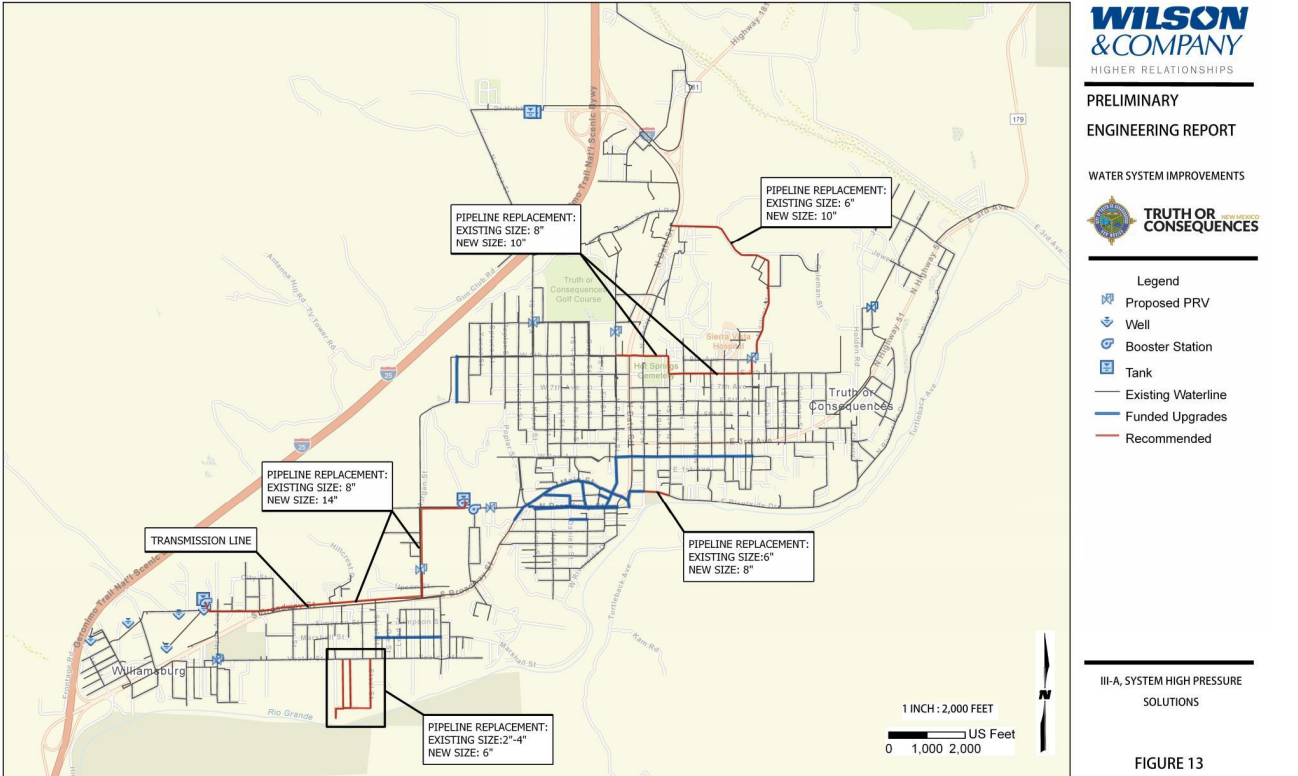
WSPI 1 will tame the city’s high/low water-pressure problems–the cause of many water leaks. Eight pressure relief valves will be installed, setting up controllable water zones. It will also replace the water line that runs from the Cook Street Station to the Morgan Street Booster Station. Cook Street receives the city’s well output, six wells in all. There the water is treated with chlorine and then sent to the first booster station, Morgan Street. Other water lines will also be replaced, nearly three miles of line in all.