

Truth or Consequences’ new auditing firm, Jaramillo Accounting Group, was a refreshing disciplinarian compared to the easy-A auditing firm, Patillo Brown & Hill, which had reached the state’s maximum six-year contract renewal limitation.
The grades are always at the end, and instead of the usual one or two “findings” under Patillo, there were seven under JAG for the fiscal year starting July 1, 2024 and ending June 30, 2025.
During Patillo’s tenure the city went through several city managers and chief financial officers. Both City Manager Gary Whitehead and Chief Financial Officer Jocelyn Holguin are newish and this latest audit partially predates their time.
They have made massive headway in cleaning up the city books and instituting financial controls, but still have a ways to go to correct historically lax accounting practices, as the audit shows.
Two big issues were frankly exposed, with Scott Eliason of JAG speaking plainly at the May 13 city commission meeting.
First, the city has improperly clung to cash-basis accounting versus accrual accounting. Patillo, and other auditing firms the city has hired in the past, have converted the city’s cash bookkeeping into accrual financial statements, but Eliason pointed out that this is an auditing no-no. It destroys the accounting firm’s “neutrality” to essentially approve self-authored financial statements.
Accrual accounting requires that the city have ongoing and end-of-year figures for each current, newly hired and fired employee’s compensated absences, vacation days, retirement benefits that rack up the city’s future debt and subtract from its overall worth.
Accrual accounting also requires the plug in yearly figures for tangible assets and inventory–addtions and disposals and their depreciation.
Whitehead and Holguin said staff will have to be trained and the city will need to add more software to its central system, “Tyler ERP,” which will cost about $7,000.
Second, and related, is creating and maintaining the tangible capital assets and inventory records that substantiate the end-of-year figures.
City staff have not been forced to keep inventory and capital assets records in the past. It will take massive amounts of time, training, discipline– and a disciplinarian–to impose a whole new way of carrying on city business.
Whitehead and Holguin expressed their worries about instituting this new tracking and computing requirement onto a staff already working hard in the field and at their desks.
JAG’s Eliason pointed out that their firm, when hired to do an audit about 10 years ago under then-City Manager Juan Fuentes, “was not comfortable giving an opinion” on the city’s assets valuation, since there were no documents backing up their existence or worth or age, etc.
Whitehead told the city commission “the city should have taken care of this years ago.”
Without accrual accounting and tangible assets records, who knows how much the city is worth or how much debt it is racking up?
The auditing firm gave the city until the end of June to correct its accrual and assets accounting problems, which is a nearly impossible deadline to meet. Expect repeat findings next year.
Some highlights of the audit, which can be found here: https://www.nmdfa.state.nm.us/wp-content/uploads/2024/06/Model_Accounting_Practices_Manual___2025.pdf
The city has $24.3 million in current assets (liquid, could be converted to cash in a year) and $3.3 million in current liabilities (due within a year), which figures, when divided, give a ratio of 7. The Civic Federation and Investopedia state that a ratio of 1 to 2 is good, so this is an excellent ratio of liquid assets to short-term debt ratio for the city–it can pay its short-term bills and obligations.
Is the city too leveraged? Is it borrowing too much? Living on borrowed time and money? No.
The city’s stability and solvency in the long run is good, not excellent, if its assets are not inflated. As the audit findings point out, the city’s assets have not been “substantiated.”
But assuming they are correct, the city is likely to remain stable and solvent.
The Civic Federation and Investopedia state that if the long-term liabilities are 50 percent or less than a city’s total assets, it should be solvent in the long run.
The city has $27.3 million in long-term liabilities and $24.3 million in short-term assets and $54.6 million in long-term assets, or $78.9 million in total assets. $27.3 divided by $78.9 million is .346 or about 35 percent, which is below the 50 percent threshold.
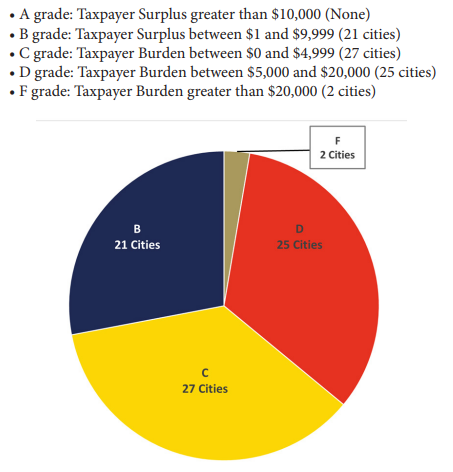
The Truth in Accounting organization would give the city a grade of C. It is a nonprofit think tank in Chicago with the mission of “government fiscal transparency and the use of full-accrual accounting.”
In its 2025 Financial State of the Cities report, it ranked 75 cities by taking the net position figure and subtracting it from total liabilities. How much positive or negative cash is left determines a city’s ranking. This method exposes how much liquid cash a city has compared to the debt it’s racking up. Inflated assets are stripped from the equation.
Cities having a “taxpayer surplus” of over $10,000 per capita earned an A. None of the 75 did.
Cities having a taxpayer surplus between $1 and $9,999 per capita earned a B. Twenty-one cities did.
Cities having a per capita “taxpayer burden” of 0 to $4,999 earned a C. Twenty-seven cities did.
Find the whole report here: https://www.truthinaccounting.org/library/doclib/Financial-State-of-the-Cities-2025.pdf
T or C, as seen on page 13 of the audit, has a net position of $17.8 million. Its total liabilities are $3.3 million short-term and $27.3 million long-term or $30.6 total. That leaves minus $12.8 million. The city’s population is about 6,000, so the taxpayer burden is about minus $2,133 per capita, giving the city a C.
The balance sheet for the County should also reflect the debt for the Spacepork American. The consumers of Sierra County are servicing that state debt through a sales taxes that has no sunset. That means that the ability of the residents of Sierra County is limited to service other bonded debt, that may be levied by the County The sales tax is a drag on appropriate economic development measures and the taxpayers ability to service existing County debt.
I sometimes wonder how so many of these little towns in New Mexico, which have historically had a pleasant, peaceful atmosphere and an interesting and historic past, and have been a great place to visit as a break from hard work in Albuquerque, or Santa Fe, in the 90s and 2000s, can possibly deal with the courtship of corporations with a list of assets that dwarfs theirs. I know that might make me sound like an outsider but it just seems like an unequal relationship no matter how you look at it.
I wanted to add, thank you, Kathleen, for your hard work, because I don’t know if there’s anyone else around here that has it’s in them to do what you do. So without you we’d really be in darkness.