

Your local government’s budget and Infrastructure Capital Improvement Plan are the two big yearly documents you should pay attention to if you want a say so in shaping community values and in determining that your public monies go toward supporting those values –your income taxes, property taxes, gross receipts taxes, gas taxes, utility fees, etc.
Hopefully your values are democratic, that is, you support measures that are of benefit to all in a pluralistic society, with pluralistic views allowed in a consensus-building process.
Democracy requires an informed citizenry who insist their elected officials provide them with factual and evidence-based information.
The elected officials, in this case T or C city commissioners, as the legislative branch, are duty bound in turn to require evidence-based reporting and fact-finding from city employees, the executive branch.
The reports should be made available–and understandable–to an informed public. It’s an ongoing process necessary to maintain a well-run democratic government that serves the people.
If the public simply “trusts” their elected officials instead of continually informing themselves and checking their elected officials by questioning them, their reporting, their information sources and their decision-making–in public, not behind closed doors like good old boys, wink, wink–democratic government slips and serves special interests.
If the elected officials simply “trust” city employees and don’t exercise their duty to check city staff, the city’s democratic government similarly slips and the people are ruled by unelected administrators.
One can easily gauge a local government’s democratic health by looking at the quality of its reporting and information gathering and record keeping. A good government keeps good records and does its research knowing it needs to give an accounting to the public.
Neither the public nor the city commission questioned what state the city’s assets were in for many generations and now we are paying the costs. Capital projects that normally would be spread over many years by good planning must be crammed into about five years.
The neglected water system was leaking up to 70 percent of the water produced during warm months a few years ago. It leaked about 57 percent during last year’s warm season.
The New Mexico Environment Department put the city under an order around December 2024, a few months before Whitehead was hired in late February 2o25. It was lifted around February 2026 after City Manager Gary Whitehead presented engineered plans and funding plans to fix the problems pointed out in the order.
Evidently an un-watched and unquestioned government was what the people wanted. Perhaps increased taxes and utility fees have awakened their interest.
The most efficient and effective way to maintain one’s informed-citizen and participating-citizen badges at the local government level? Look at and question the budget and ICIP and show up at their associated public hearings.
Budgets should be understandable, not full of insider codes. If it’s not, citizens should question and complain until it is understandable.
The ICIP article last week and link to ICIP document: https://sierracountycitizen.org/citizens-should-prep-for-infrastructure-capital-improvements-plan-public-meetings/
The T or C city packet link to the interim budget that was discussed at the April 14 special meeting: https://cms5.revize.com/revize/truthconsequencesnew/4-14-28%20CC%20Budget%20Workshop%20Packet.pdf?t=202604101502160&t=202604101502160
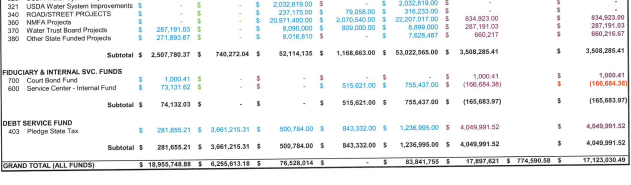
The proposed budget for the fiscal year starting July 1 and ending June 30, 2027 is $83.8 million, of which $30.8 million is yearly operations and debt and $53 million is capital projects. Please refer to pages 22 and 23 of the packet which summarize the overall budget.
$53 million is a much bigger city’s capital project budget. Las Cruces budgeted $191.6 million in capital projects this fiscal year, which ends June 30. https://lascruces.gov/council-reviews-fy26-budget-and-cip-plan/
Las Cruces has a population of about 117,000 and T or C has a population of about 6,000, which is 5 percent of Las Cruces’ population. A commensurate capital projects budget, 5 percent of $191.6 million, would be about $9.58 million.
T or C is taking on capital projects that should be spread over many more years in a short period of time because it let its water and wastewater infrastructure deteriorate to the point that crisis-level repairs are necessary. That’s not good governance. It shows a lack of planning. It’s not good for the people either. Taxes and utility fees have gone up enormously.
The good news is the city hired a very good city manager a little over a year ago, Gary Whitehead, who has greatly improved transparency and record keeping and internal planning.
I applaud the transparency of how city employees’ salary expenses are laid out. This is any city’s largest public expense. Starting on page 260 of the budget packet are electric department employee’s pay and insurance costs. The work year is 2,080 hours for all employees, standardizing how salary and hourly rates are estimated for all departments.The department director is paid $49 an hour for 2,080 hours a year, which comes to nearly $102,000 a year. Past budgets didn’t show the positions, titles or numbers of employees. Insurance, such as workers’ compensation, is similarly standardized.
You can watch the all-day April 14 session on the city’s YouTube channel at:
Go to the “live” tab, under which you will see four videos for April 14.
Thank you for this excellent reporting Kathleen.