
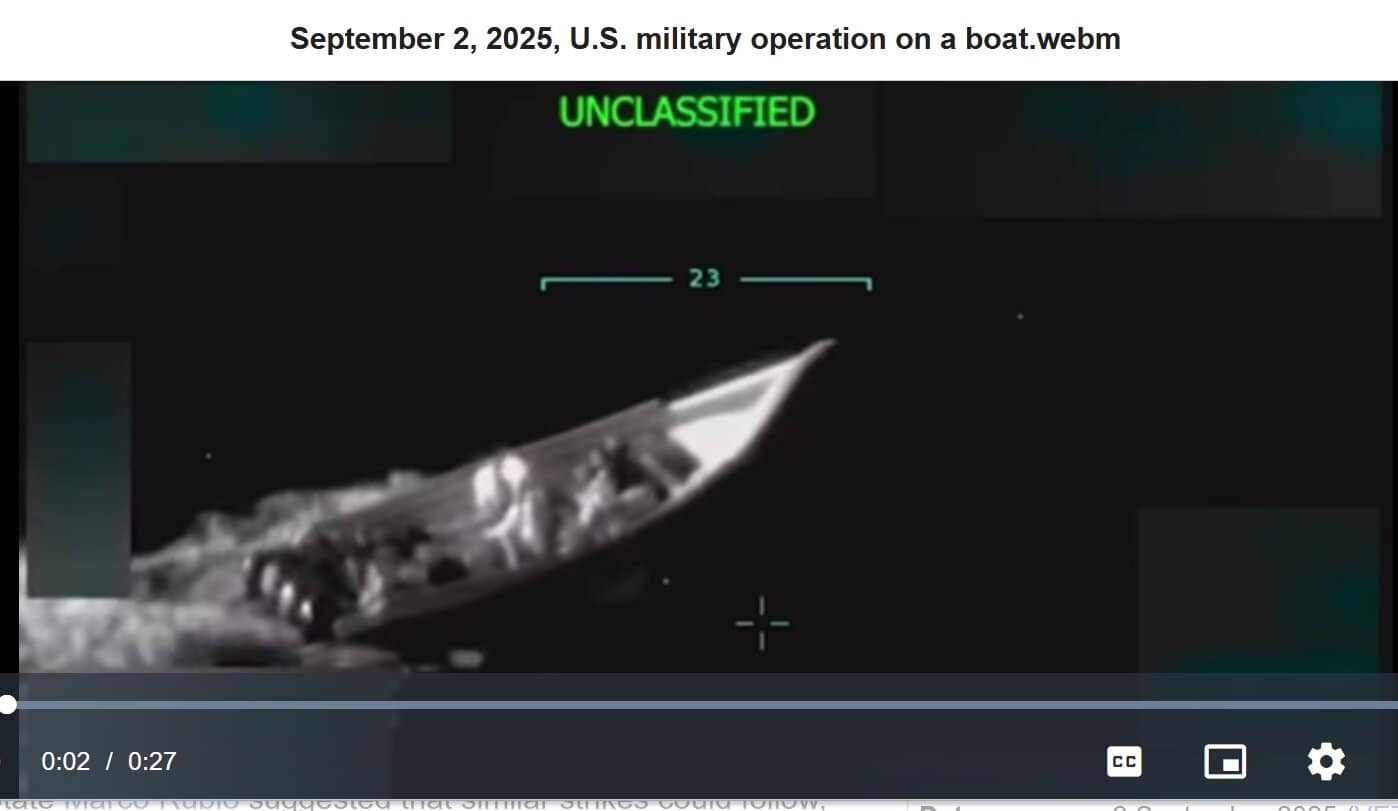

In 1969, American soldiers in Vietnam killed some 500 unarmed civilians in a village called My Lai. Seymour Hersch called it “point blank murder.” Though there was proven evidence of the killing spree and though there was a proven cover-up, only one person was convicted of the My Lai Massacre, and he served only three years of a life sentence. Still, there was a public outrage at the killings, and there was a trial. There was at least a public recognition that soldiers do not target civilians, even in times of war. Yet, last week, the US Navy assassinated 11 civilians, not in time of war, summarily executed them over an alleged criminal offense not yet even committed, and not even within American jurisdictional territory.
This is news of an important shift in how government works and what the military does. We now live in a country run by assassins, and the government can and does kill whomever it wants for whatever reason it likes. For our President, it’s only a way to “send a message.” It makes our sub-President proud, vigorous, and wish for more killings, good Christian that he is. Our Secretary of State hankers after a declaration of war to make such killings look legal.
But even if the Department of Defense is called the Department of War, our leaders seem to scramble the meanings of words, confusing literal and figurative uses of words (metaphors, anyone?). War is fought between countries, between the governments of countries, between armies. We do not send the military to machine gun cancer patients in a “war against cancer.” If our leaders believe their war against drugs is not a criminal affair for which the government has law enforcement powers but is, instead, a military affair — a war — then, our leaders are 1) bad-mouthing law enforcement, and 2) acting themselves like a gang. This attack is not warfare but gang-fare, a rumble (over territory?). The US government has become a special kind of powerful gang, as one might expect having elected a criminal as our president.
For a considered explanation of this shift (rather than my rant) see Professor of Law, and former legal consultant for the government, Marty Lederman’s article, The Many Ways in Which the Caribbean Strike was Unlawful. Professor Lederman focuses on the long-standing policy of the American military to avoid killing civilians and imagines ways in which this act of murder could have been promoted to the individuals who carried out the assassination.
Thank you for covering this, Max.
It’s distressing to say the least.
Thank you for the information. It’s shocking and yet not surprising how this administration is using the military to erode our humanity.
Thank you for this. A number of commentators have recently observed a shift toward assassination (because that is what it was) as a mode of war; note recent killings of Hamas negotiators, Yemen civilian leaders, multiple assassinations of Iranian negotiators and leaders. I have come across no evidence whatsoever that the Venezuelan boat was running drugs. As far as I know, no effort has been made to identify the owner of the boat or the people who were murdered. The type of boat, called a “cigarette” boat, cannot carry enough fuel to get it from Venezuela to the US. Former CIA analyst Larry Johnson offers a knowledgeable assessment here:
“Cigarette boats typically come equipped with large fuel tanks, generally ranging from 200 to 250 gallons in total capacity. For example, the Cigarette Top Gun model—one of the most popular hulls—often features dual tanks with a combined capacity of approximately 220 gallons (two 110-gallon tanks). A typical cigarette boat with three outboard motors will burn approximately 28–35 gallons of fuel per hour per engine at wide open throttle, which amounts to 84–105 gallons per hour in total when running all three engines at maximum power. At normal cruising speeds, fuel consumption can drop to about 18–25 gallons per hour per engine, for a combined 54–75 gallons per hour for the boat.’
“A cigarette boat with a 220-gallon fuel tank can typically travel between 286 and 330 miles on a full tank under normal cruising conditions. This estimate uses a cruising fuel efficiency of about 1.3–1.5 miles per gallon, based on common data for these high-performance boats. There is no way in hell that his boat was headed to the United States. Let’s assume that the boat departed from Maracaibo, Venezuela. The distance by water from Maracaibo, Venezuela to the Florida Keys is approximately 1,014 nautical miles, which is about 1,167 statute miles (1,878 km). This measurement reflects the shortest direct route between Maracaibo and Key West in the Florida Keys, often used as the reference point for the archipelago.’
“The maximum weight capacity (also referred to as the maximum load or maximum displacement) of a cigarette boat varies by model, but typical figures can range from about 10,000 pounds (4,500 kg) for smaller 38-foot models up to around 33,000 pounds (15,000 kg) or more for larger, high-performance models like the 52-foot Cigarette 52 Thunder. If we assume that the average weight of the 11 people on the boat was 180 pounds, that is 1980 pounds of weight. The four outboard motors on that boat weighed a combined 2,800 pounds. If this boat was heading for the United States, it would have to carry around 2,000 pounds of fuel. Discounting the 220 gallons of gas already in the tanks, the boat would have to have an additional 339 jerry cans of fuel onboard to make it to Key West, Florida. Add all of this up and we have a total weight, without counting the alleged drugs onboard, of 6,780 pounds. This means that the boat could conceivably carry about 26,000 pounds of drugs. If each bundle of drugs weighed 100 pounds, that means we should have seen at least 260 bundles stacked in the boat.”
https://larrycjohnson.substack.com/p/with-donald-trump-its-a-mad-world
However, although discrete knockouts, often facilitated by high-tech monitoring equipment, may be an up-and-coming military strategy, the US behavior toward Latin America is anything but new. Most of us can recall Trump’s first term attempt to install Juan Guaido in Venezuela few years ago. But US intervention goes back far longer than that, as detailed in this exquisitely detailed review by Ben Norton:
https://www.youtube.com/watch?v=I9uKtxS7Ssc