
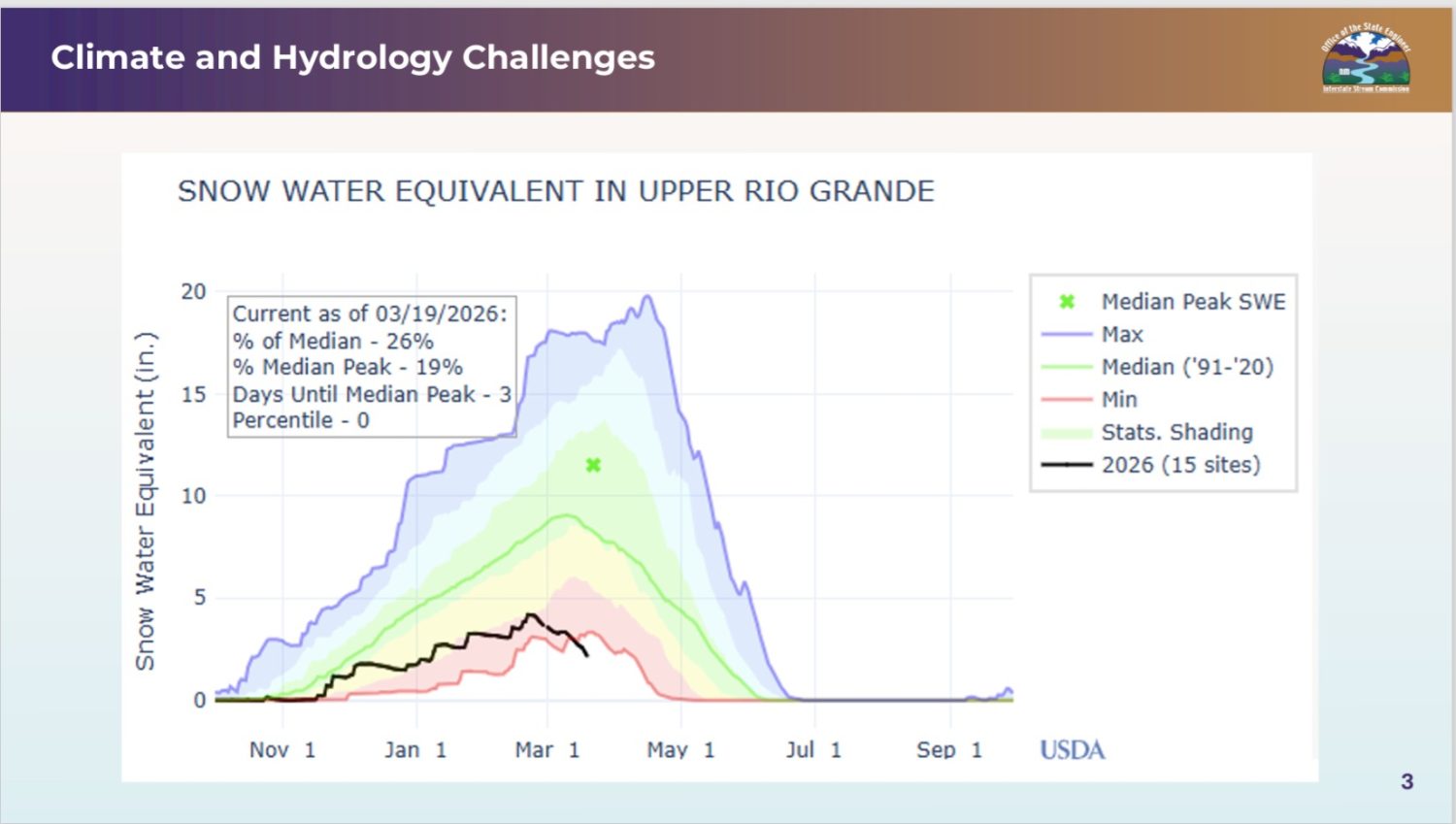

Take a close look at the USDA graph above. It was presented by Hannah Riseley-White, director of the Interstate Stream Commission which regulates the water flow of the Rio Grande at a workshop on the crisis in the Middle Rio Grande basin. The graph represents the water from the winter snowpack that provides water for the Rio Grande in equivalent inches plotted against the six months of the year when there is snow runoff.
The blue line represents the maximum snow runoff in the river. The green is the median snowmelt (half the flows are above this line and half below). The red line shows the minimum snowmelt over the years. Each line has a shaded area that shows the extent of the yearly variations.
Then there is the black line. That is us right now, this year. The black line has crossed below the red line. That means that we are experiencing less snowmelt in the river than at any time since measurements began: less than 4 inches of snow water equivalent. Also, importantly, the black line peaked much earlier than the other curves. Notice the little green square, which shows the median peak. That is, we are already well on our way downwards when even in dry years in the past, we had rising water levels at this time of year.
No water in the Middle Rio Grande means no water going into Elephant Butte Reservoir. And, that means no water for the Lower Rio Grande which is already facing its own legal problems taking Texas and Mexico waters out of the river. New Mexico may be facing another Rio Grande Compact violation shortly, this time on Middle Rio Grande’s failure to deliver water to the Reservoir.
What we are seeing, in the graph and in reality, is not drought. We’ve had major droughts before, like in the fifties, but we’ve never seen this kind of scarcity of water. This is climate change. The loss of water for New Mexico is permanent. Meanwhile, our leaders are still talking development, bring more people, start more businesses, bring back mining, green those golf courses, and build new industries.
Here is the link to Laura Paskus’ new article on water in the Middle Rio Grande: “Climate change, overuse send the Middle Rio Grande into ‘dire’ situation” published March 20th by Source New Mexico (https://sourcenm.com/).
How much or how little will the lack of stream flow be compensated for by well pumping?
Mr. Gioannini,
You ask a very real and important question but one that is almost impossible to answer. Since the 1960s (actually since the City of Albuquerque v. NM case), the state has administered surface water and groundwater conjunctively, meaning that we legally recognize the connection between the river flow and groundwater wells nearby. That connection, however, goes both ways. When the river flow is low, as it is this year, nearby groundwater levels will drop. When you pump on wells near the river, it decreases the flow. When Caballo Reservoir was formed, all the local wells showed a huge rising of water levels.
But to quantify that connectivity is almost impossible. It obviously depends on the location of the well, the geography of the aquifer, the location of underground streams, the actual amount of river flow, timing, seasons, etc. Therefore, there would be a different situation for each well, and we cannot model each well in such a large area in its relation to the river. Even a generalized model of an aquifer is difficult; though the state has embarked on a project to make aquifer maps of the whole state.
For the Lower Rio Grande Basin (not for the Middle Rio Grande Basin, which was what the article was about), the relation between river flow and groundwater is the central issue. Texas and the US claimed that New Mexico was snitching its surface water by allowing (permitting) wells that communicated with the river. Tens of thousands of pages of data went into that litigation, and one can get a generalized answer to your question from them. The settlement of that litigation (which agrees to no fault being declared) specifies that 18,200 AFY of water that NM farmers and others had withdrawn by tapping into the river flow through their groundwater wells have to cease.
That number comes from the discovery that over the last 70 years or so, total irrigation water (mostly from surface flows of the river) has held steady, in spite of a huge increase in total acreage irrigated. This was due to technical improvements in water use and delivery. However, groundwater use (which means municipalities (i.e. Las Cruces, but T or C, also), individuals, commerce, industry, etc.) had increased by 18,500 AFY (i.e. development water). The parties agreed to return to that earlier time period by requiring NM somehow to find and give up the use of 18,200 AFY, by “retiring” the rights to the use of that much irrigation water. The bulk of the retired rights will be from farmers who have used wells to supplement the lack of flow in the river. But there is an element of this agreement which seems to me to protect economic development since most the water will be coming from agricultural uses.
Both sides of the litigation hope doing this reparation and doing voluntary water savings will secure a better looking future, but in a pinch, the state can fall back on priority administration, that is, honoring the priorities of water rights. “Priority of appropriation shall give the better right,” says the state Constitution. River water is senior to other rights in New Mexico. Furthermore, Compact water in the river has precedence over New Mexico water in the river. So, if push comes to shove, groundwater rights will have to be restricted or temporarily unexercised.
I think a proper answer to your question is to say that the issue is societal and cultural. The depletion to the river comes not from one individual or one class of water users. It’s a problem that all of us contribute to, even though our individual contributions may not be measurable or discoverable. Yet, the problem is there. It can be addressed (so water managers hope) by getting people massively, as a society, to acknowledge the problem, to admit the constraints that prevent an easy solution, to work out voluntary agreements that address, as much as possible, common interests. We begin by understanding that there is no solution to the water shortage. A few good years will not reverse climate change. All we can do is try to make life better than worse.
As you see from my discussion of the relation between groundwater and river water, any groundwater that is used to compensate for low river flow also depletes the river even more while lowering groundwater. However, compensation is itself a complicated business. Albuquerque has a system that can control the use of both groundwater and river water, because it stores water in its aquifer, injecting river water when it is plentiful and pumping it out when it isn’t. It also treats its sewage water (some of which originates as groundwater) and pumps it into the river as surface water. Here is a diagram of Albuquerque’s system: https://www.abcwua.org/wp-content/uploads/Your_Drinking_Water-PDFs/Figure1_Where_Our_Water_Comes_From.pdf.