
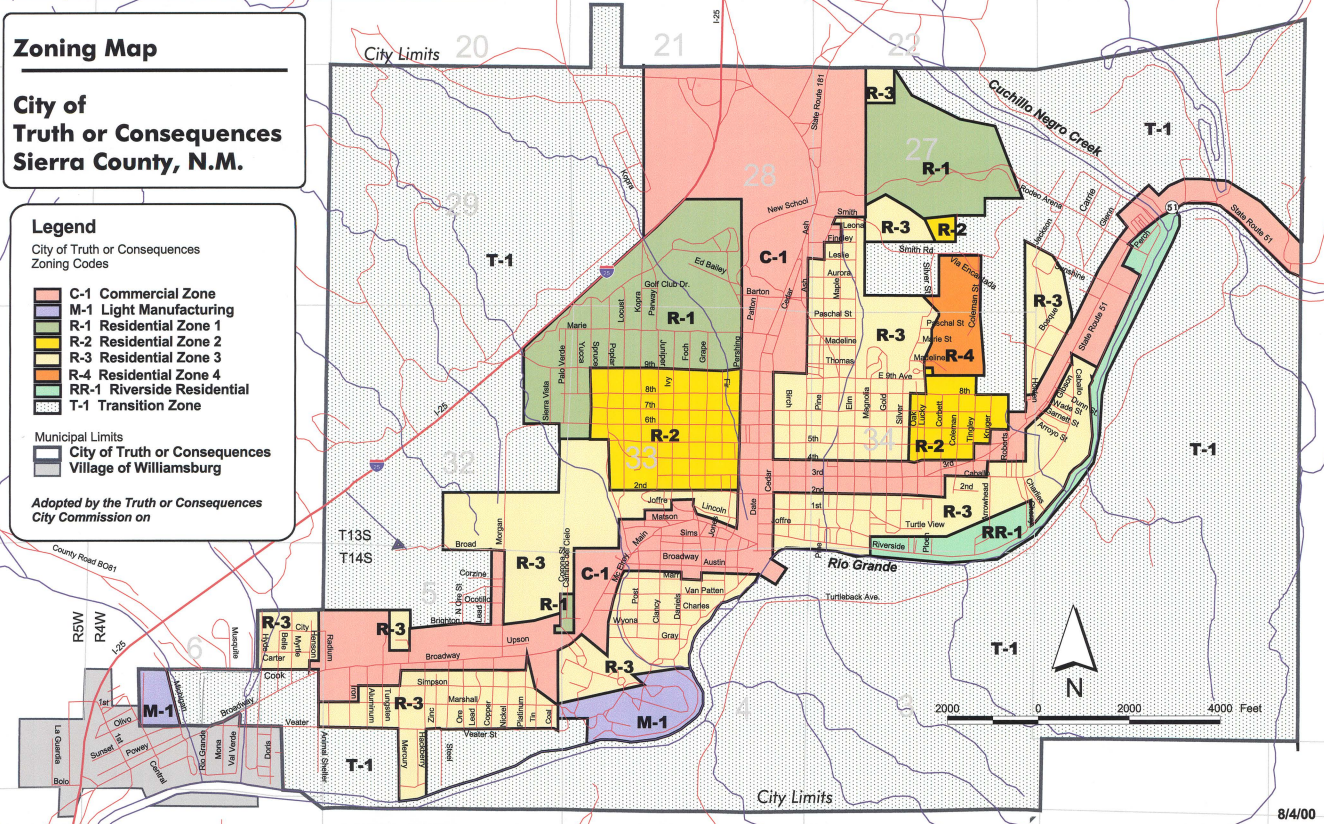

Truth or Consequences and Sierra County will soon enter into a memorandum of understanding that is supposed to solve issues arising from developers seeking city utilities and services just outside city boundaries.
The MOU was on the city’s Aug. 12 agenda. The county commissioners already approved the document at an earlier meeting. The T or C Commission approved City Manager Gary Whitehead and City Attorney Jay Rubin negotiating a final MOU and Whitehead signing it for the city.
Whitehead said he and Rubin had been negotiating with County Manager Amber Vaughn and County Attorney Dave Pato.
T or C Assistant Manager Traci Alvarez, the city’s designated zoning administrator, told commissioners the city is receiving inquiries from developers interested in county land just beyond the new Love’s Travel Stop (which is inside the city). Love’s paid about $200,000 to extend the city’s main water and sewer lines to its property and also an unknown amount to extend city electric lines. These extensions have made the county land across the street (Cemetery Road) more viable for development.
Developers interested in the Village of Williamsburg property have also made inquiries about how to get city utilities and services, Alvarez said.
Williamsburg is a different municipality within Sierra County that has a boundary partly contiguous with T or C.
The MOU is needed so developers outside the city getting city utilities and services “have to follow our standards and not have adjacent businesses with different standards,” Alvarez said.
City Manager Gary Whitehead similarly told city commissioners that, “businesses could come to us for water, wastewater, electric and other city services and we would have no zoning authority. . . if they connect to our system, then they have to follow our zoning. They can’t mix and match county and city zoning.”
Whitehead added that “the county doesn’t want to give up their authority.”
State law anticipated there would be zoning authority issues among counties and cities and adjacent municipalities and clarified which has supremacy in state law 3-21-2. T or C could just exercise its extraterritorial zoning authority under this state law instead of pretending it has none. The MOU with the county adds a layer of unneeded government, puts two head cooks in the kitchen and ad hoc decision making for each developer’s application a formal arrangement, instead of the city taking control.
It is not accurate for Whitehead to say that the city has no zoning authority outside its boundary. It does, up to a mile outside its boundary.
T or C could exercise its superior extraterritorial zoning authority over the county to ensure all businesses within a mile of the border follow city building standards and zoning standards.
T or C could even pass a zoning law that insists that development within a certain number of feet from a water or sewer main or electric line–up to a mile of the city boundary–hook into city services.
The law 3-21-2 states that T or C has superior zoning authority over the Village of Williamsburg as well, since it has a population over 2,500 and VOW has a population less than 2,500.
If T or C wants to share “concurrent” zoning authority with the county or Village of Williamsburg, then it must do so by passing a Joint Powers Agreement, according to the state law–a much heftier document and involved process than an MOU.
See state law 3-21-2 below:
3-21-2. Jurisdiction of a county or municipal zoning authority.
To carry out the purposes of Sections 3-21-1 through 3-21-14 NMSA 1978:
A. a county zoning authority may adopt a zoning ordinance applicable to all or any portion of the territory within the county that is not within the zoning jurisdiction of a municipality;
B. a municipal zoning authority may adopt a zoning ordinance applicable to the territory within the municipal boundaries and, if not within a class A county with a population of more than three hundred thousand persons according to the last federal decennial census, shall have concurrent authority with the county to zone all or any portion of the territory within its extraterritorial zoning jurisdiction that is within:
(1) two miles of the boundary of any municipality having a population of twenty thousand or more persons, provided such territory is not within the boundary of another municipality;
(2) one mile of the boundary of any municipality having a population of one thousand five hundred or more but less than twenty thousand persons, provided such territory is not within the boundaries of another municipality;
(3) the limits of the boundaries of a municipality having a population of one thousand five hundred persons or less; or
(4) territory not lying within the boundary of a municipality but within the extraterritorial jurisdiction of more than one municipality; provided that the extraterritorial zoning jurisdiction of each municipality shall terminate equidistant from the boundary of each municipality unless one municipality has a population according to the most recent federal decennial census of less than two thousand five hundred and another municipality has a population according to the most recent federal decennial census of more than two thousand five hundred, in which case the extraterritorial zoning jurisdiction of the municipality having the greatest population extends to such territory; and
(5) territory in addition to the extraterritorial zoning jurisdiction provided by Paragraphs (1), (2), (3) and (4) of this subsection that the governing bodies of a county and a municipality agree to place within the extraterritorial zoning jurisdiction of the municipality by agreement entered into pursuant to the provisions of the Joint Powers Agreements Act [11-1-1 to 11-1-7 NMSA 1978], provided such additional territory is not within the boundary of another municipality and is contiguous to the exterior boundaries of the territory within the extraterritorial zoning jurisdiction of the municipality;
C. concurrent authority shall be exercised pursuant to an extraterritorial zoning authority or joint powers agreement; provided, however, this authority may be exercised regardless of whether a county has enacted a comprehensive zoning ordinance; and
D. in the absence of a county zoning ordinance, a qualified elector may file a petition, signed by the qualified electors of the county equal in number to not less than twenty-five percent of the votes cast for the office of governor at the last preceding general election, seeking the adoption of a zoning ordinance by the county zoning authority. Within one year of the filing of the petition seeking the adoption of a county zoning ordinance, the board of county commissioners shall adopt a county zoning ordinance.
State law does allow for another option, a less formal arrangement besides T or C exercising superior zoning authority or passing a joint powers agreement to obtain concurrent authority.
T or C and Sierra County can instead enter into an agreement, an option not given to an adjacent municipality, such as the Village of Williamsburg.
See state law 3-21-3 below:
3-21-3. Procedure for extraterritorial zoning.
A. Upon the initiative of any municipal governing body or of the board of county commissioners of any county wherein any portion of the extraterritorial zoning area of the municipality lies, the municipality and the county may enter into an agreement providing for the zoning of that portion of the extraterritorial zoning area lying within the county joining in the agreement. In the absence of such agreement, a petition requesting the zoning of the extraterritorial zoning area and signed by twenty-five percent of the qualified electors residing in the extraterritorial zoning area and within the same county may be filed with the county clerk of the county of the petitioners’ residence. Upon the filing of such petition, the governing body of the municipality and the board of county commissioners shall enter into an agreement providing for the zoning of that portion of the extraterritorial zoning area lying within the county joining in the agreement. Any agreement entered into pursuant to the provisions of this subsection may be subsequently amended by agreement of both parties.
B. The agreement entered into pursuant to Subsection A of this section shall provide for an extraterritorial zoning commission consisting of equal numbers of members appointed by the municipal zoning authority and the county commission; provided that at least one-half of these members shall reside in the extraterritorial zone. Additionally, one member from an area of the county not within the zoning jurisdiction of the municipality or within the area of the county affected by the proposed extraterritorial zoning ordinance shall be appointed by a majority of the members appointed by the board of county commissioners and by the municipal zoning authority. The agreement shall also provide for a joint municipal-county zoning authority consisting of one or more members of the municipal governing body and one or more members of the board of county commissioners, provided such authority membership shall contain one more county commission member than municipal governing body member.
C. No zoning ordinance shall be adopted by the joint municipal-county zoning authority unless the ordinance has been recommended by the extraterritorial zoning commission.
D. Within three hundred sixty days of the appointment of the last member to be appointed, the extraterritorial zoning commission shall recommend to the joint municipal-county zoning authority a zoning ordinance applicable to all or any portion of the extraterritorial zoning area lying within the county joining in the agreement pursuant to Subsection A of this section. The ordinance shall also provide, subject to the restrictions of Section 3-21-6 NMSA 1978, for the manner in which zoning regulations, restrictions and the boundaries of districts are:
(1) determined, established and enforced; and
(2) amended, supplemented or repealed.
The MOU T or C and the county have nearly passed is very loose. It says repeatedly that the city and county retain their individual authorities. Each applicant seeking city services and/or utilities will be considered on a case-by-case basis. The city, the MOU makes clear, is never obligated to provide services to applicants, but if it does, then the applicant must conform to all city zoning laws, utility rates, and building standards. It’s unclear if the county has veto power, since its commissioners sign off on the application.
The agreement also puts the applicant in the driver’s seat. Only if a developer seeks city services and/or utilities is the MOU activated. Therefore it would not ensure any uniformity in standards or zoning for adjacent businesses just outside the city’s border unless those businesses both sought city services and/or utilities.
Wouldn’t it be better for the City of T or C to simply exercise its state-given extraterritorial zoning authority to ensure the uniformity and upholding of standards just outside its boundary?
The only thing this MOU accomplishes are the steps for sharing information on applications coming into the city or county from developers, which is important.
The county has no zoning laws, therefore if the city doesn’t exercise its extraterritorial zoning authority, development at its edge could be haphazard and inconsistent.
See the link to the MOU below, which runs from page 236 to 241 in the city packet: