
I.
On April 29th, a majority of the Supreme Court of the United States decided a case called Louisiana v. Callais. Associate Justice Samuel Alito wrote the majority’s Opinion explaining the reasons for the Court’s decision. The case is actually two related appeals which the Court consolidated.
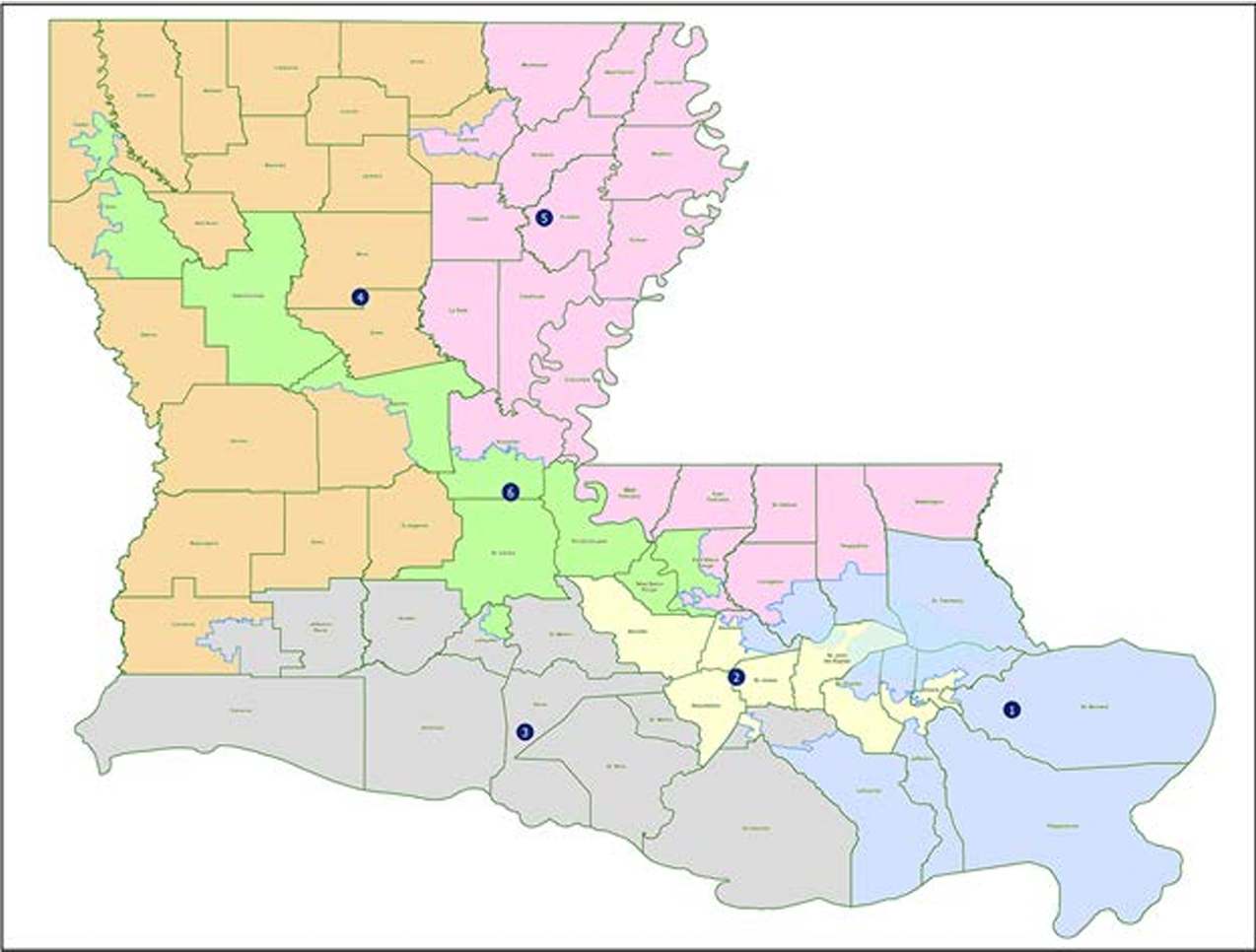
In 2022, the Louisiana legislature, based on the 2020 census which allowed the state six seats in the House of Representatives, drew a voting map with six districts of which only one had a Black majority, whereas the census had found that the state was about one third Black. The map was contested in court. After some maneuvering, the federal court required the legislature to redraw the map, which it did in January 2024, creating a second majority Black district. That map, known as “SB8,” was challenged in court by a group calling itself “non-African American voters.” SB8 is the map is shown above; District 6 (in green) is the new Black majority district which the non-African Americans claimed violated their rights. A panel of three federal judges heard that second case and decided in favor of the non-African American voters: that SB8 was unconstitutional. So, both of Louisiana’s redistricting maps were considered illegal, one for discrimination against African Americans and one for discrimination against non-African Americans.
Two appeals to the Supreme Court came out of the decision on SB8: a group of Black voters and organizations contested the decision and the State of Louisiana asked the Court to stay the decision because it was too close to the 2024 elections for the state to create a new redistricting map. In 2024, the Supreme Court allowed Louisiana to use the original, January, illegal map for the elections. Now, in deciding Louisiana v. Callais, it has upheld the three judge district court’s decision that SB8 unconstitutionally violated the rights of the non-African American voters.
In explaining the Court’s decision, Justice Alito has also ended Congress’s ability in the future to make any meaningful address to any issues of race. His quarrel with the Voting Rights Act, which governs issues of redistricting, turns out to be a quarrel with the Constitution (which, of course, governs what Congress can do). Louisiana v. Callais comes close (not quite) to saying that the Constitution is unconstitutional. Justice Alito has effected a Constitutional change without having to go through the deliberately difficult task of an amendment.
You have no doubt read in the news that Louisiana v. Callais is a landmark decision which ends an era of civil rights activism by the federal government and at the same time gives a major boost to Republican chances of a majority House of Representatives after the present national elections. I want to begin a series of deep dives into Justice Alito’s Opinion to show how he managed to change a history of national interest in protecting civil liberties.
We should begin, at least, with some clarity. The Fifteenth Amendment of the US Constitution says, “The right of citizens of the United States to vote shall not be denied or abridged by the United States or by any State on account of race, color, or previous condition of servitude.” In a second article, the amendment gives Congress the “power to enforce this article by appropriate legislation.”
We know from the textual reference to “previous condition of servitude” and also from historical documents that this is the third of the amendments to address the consequences of outlawing slavery in this country by the Thirteenth Amendment, whose second article is exactly the same as the second article of the Fifteenth. The three amendments are so closely related in meaning to one another that the voting right protection of the Fifteenth must be seen as a specific instance of the equal protection clause of the Fourteenth.
That much is clear. Even though the words “race” and “color” are themselves ambiguous today, at the time and in the context of this group of three amendments, those words were clearly appositives and jointly refer to the freed slaves, the new citizens (created by the birthright clause of the Fourteenth Amendment).
While the language of the Constitution must be general, in order to apply to all citizens and not to a specific group because of our sense of equity, it is clear that the instigating purpose of this protective law is to protect former black slaves. These three amendments were the legal fruits of the bitter Civil War. But because there is inherently a conflict between the equitable intent and the clear intention to protect a specific group of people in these amendments, their interpretation (their meaning and application) historically has been politically embattled as an ideological continuation of the Civil War, in spite of, or perhaps because of, the clarity of the incompatible intents of the language.
It is also clear that Congress is duty bound to protect voting rights from any abridgment of any citizen’s right to vote, even if it waffles in protecting African Americans. For many years after these amendments to the Constitution, former Confederate states enacted voting procedures which denied or abridged African American voting. They avoided violating the Fifteenth simply by not mentioning race, under the guise of protecting the voting integrity for all. Justice Kagan, in her dissent from Justice Alito’s Opinion in Louisiana v. Callais, lists some of these “facially race-neutral” ways of avoiding the Fifteenth: “Poll taxes, literacy tests, ‘good character’ exams, property qualifications, convoluted registration processes—all these and more, when combined with administrative discretion, effectively suppressed the Black vote, . . .”
In 1965, almost a hundred years after these amendments were added to the Constitution, Congress finally passed the Voting Rights Act, specifically to fulfill the second clause of the Fifteenth, abolishing the various ways invented to circumvent it. But the history of using facially race-neutral rules for voting to deny or abridge (“dilute” or devalue) minority votes seems to show that their variety is only limited by human ingenuity. In my reading, Justice Alito’s arguments are colored by the same kind of ingenuity.
Justice Alito’s decision in Louisiana v. Calais cleverly reinterprets the Fifteenth Amendment and Section 2 of the Voting Rights Act (the section Congress specifically devoted to articulating the Fifteenth into practical terms) based on a revised history of Supreme Court decisions on voting rights, correcting them, and filling in gaps in former arguments. “Updating” them, he claims. On the basis of this revision of case law, Justice Alito concludes that voting districts based on racial considerations, even when they are created — as in this case — in order to correct a racially biased voting map, violates the Fifteenth’s prohibition. [One wonders how these correctives to racially motivated abridgments of voting could not consider race.] In addition, the Justice argues, voting maps in which the “predominant” intention is to dilute the votes of the opposing party (partisan gerrymandering) are constitutional and not the business of the federal government and thus not “judiciable” or can’t be brought to be tried in federal courts.
As a result, states that want to undermine a racial minority’s vote can simply, intentionally, and openly undermine minority voting without any legal consequences thus using partisan redistricting as a cover for diluting minority votes. This is happening as you read this, as states hurry to break up minority districts that had been created under Section 2. Instead of waiting a month in case of a petition by the losing party, as is customary, the Court has given the lower court permission to immediately act the decision into practice. See https://www.supremecourt.gov/opinions/25pdf/25a1197_097c.pdf. This redistricting, under the guise of normal party politics will group Democratic minority voters into districts where their votes have less chance of success. The irony (or cynicism) of Justice Alito’s decision is that he claims to abhor the use of a Section 2 claim as a tool for advancing partisan ends. In such a case, he writes, the Voting Rights Act’s “noble goal will be perverted.”