
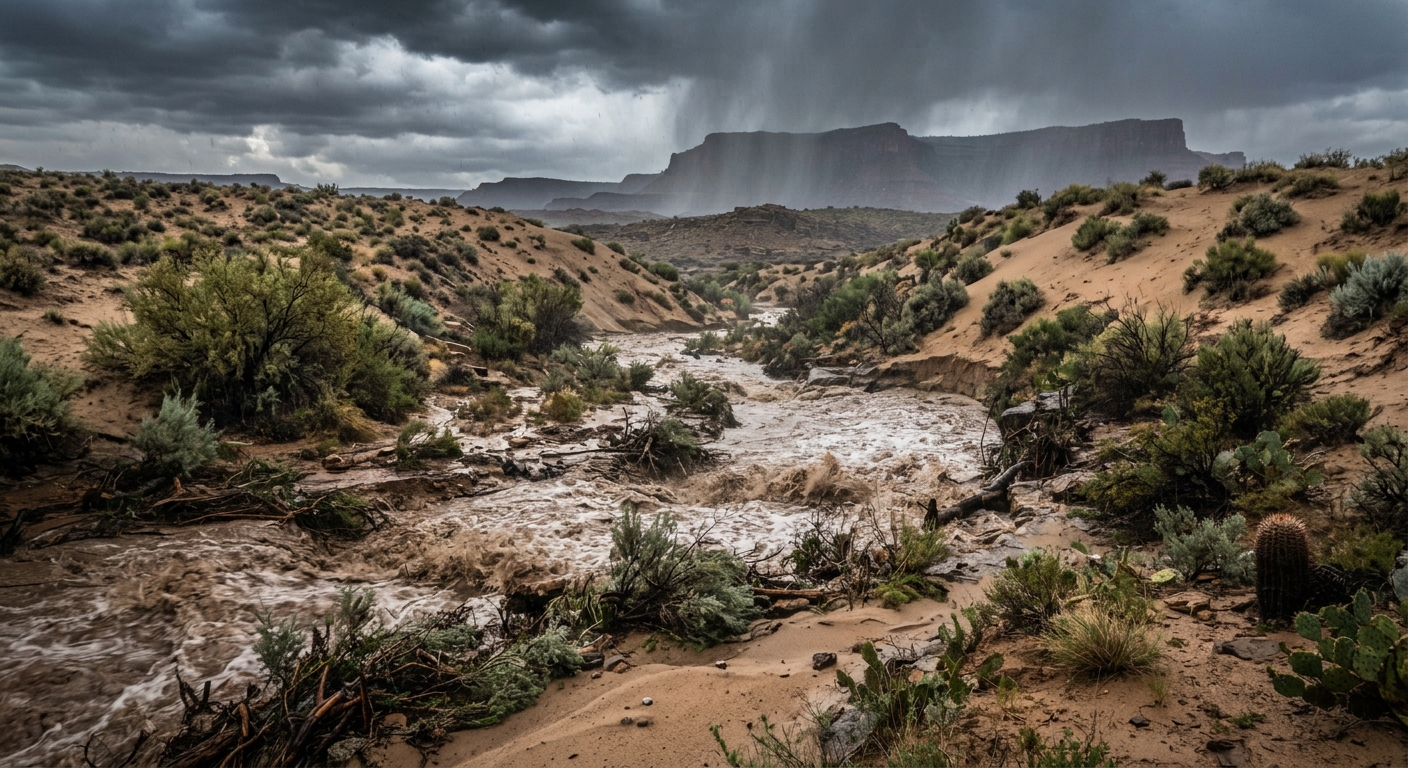

There were a lot of complaints about Sandy Jones who ran for Sierra County Commissioner but lost to Willard Hall.
Jones has been the governor-appointed flood commissioner since 2019. He’s a Democrat and Governor Michelle Lujan Grisham is a Democrat.
The complaints were mostly from Palomas Creek farmers who claimed that:
–Jones promised them $250,000 in “arroyo” repairs
–Jones has $7 million in tax money that “he’s sitting on.”
–Jones favored one Palomas Creek land owner with “arroyo” repairs while unfairly depriving other land owners of promised repairs.
The Citizen interviewed Jones Monday, Nov. 9.
Jones refuted the claims that he promised Palomas Creek farmers $250,000 in arroyo repairs.
He also said he has about $2.5 million in tax money. All property owners, including those in municipalities, pay a 1.5 mills levy for flood control, which comes to about $500,000 a year.
Jones is also one of five directors elected to the recently formed Sierra County Arroyo Flood Control District. All property owners, including those in municipalities, pay a .50 mills levy for flood control, which comes to about $170,000 a year, and this is the first year that money will start to fill that separate flood-control fund. But the Sierra County Commissioners can put increasing that tax on the ballot.
Jones pointed out that the tax money collected is supposed to be spent equitably. Sierra County has a population of around 11,375 according to 2026 U.S. Census estimates, Elephant Butte 1,455, Truth or Consequences 5,928 and Village of Williamsburg 456. If you subtract the municipalities’ populations, the unincorporated county population is 3,558.
If Jones’ $500,000 in yearly tax money were spent per capita, unincorporated county residents would share about $140,000 a year.
Before Jones became flood commissioner, Sierra County, for six or seven years, failed to bring to the governor’s attention that the Sierra County flood commissioner had died. It took the tax money and spent most of it on salaries to their road department and their newly formed position of flood director, which evidently has been eliminated, or is no longer listed on the county’s website. For more information on the county’s use of flood-tax funds, see: https://sierracountycitizen.org/flood-commissioner-sandy-jones-caught-the-county-commission-with-its-hand-in-the-cookie-jar-and-now-we-all-have-to-pay-for-it/
Historically the tax money has been used to bulldoze dirt that fell into the arroyo during heavy rains back up the banks and on top of the levees, whether it was private property, Bureau of Land Management property, or an arroyo under the jurisdiction of the Army Corps of Engineers.
Jones and the directors of the SCAFCD have agreed to work together, as determined in SCAFCD organizational meetings last year. They agreed that the tax money should be distributed equitably, as required by law, not just on county arroyos and road repairs.
Jones, as flood commissioner, has authority to work on private land, but the SCAFCD does not, which will determine how projects will be divided up and paid for by the different flood-control tax funds.
They have also agreed that tax money should be spent on permanent fixes.
Jones said Palomas Creek and other county farmers and ranchers have come to feel “entitled” to levee and road repairs. “I disagree that repeat-repairs to private property are the most efficient use of taxpayer dollars.”
Road repair, Jones said, is not the duty of flood control. During the most recent rains “the biggest complaint was road access. Only three homes flooded in the whole county,” which Jones addressed.
He was able to address those flood issues quickly because he didn’t spend down all of his money and built up a cushion for emergencies.
“If the county did the same thing, they’d be able to fix roads after a flood . A lot of those roads are still inaccessible.”
The various soil and water conservation districts in the county should also be doing more, said Jones. They collect a 1.0 mill levee, the lion’s share paid by and never seen by T or C residents. Their job is to prevent soil loss and erosion, and they could help farmers with their arroyo and levee problems. “They’ve done a good job of pushing that duty onto the flood commissioner,” Jones said.
Jones is still pushing dirt and reforming levees, “but we’re transitioning to permanent fixes.”
Jones said one of the Palomas Creek complainants who feels owed a cleared arroyo and repaired levee is a BLM permittee or leasee. Jones informed him he didn’t have authority to work on that BLM land, that it was his responsibility to get BLM’s permission, which the owner has failed to do.
Jones did repair one Palomas Creek landowner’s levee since it was all private property, he had the owner’s permission, and that levee protected many other landowners’ properties.
Jones’ more equitable distribution of tax dollars since 2019 to municipalities ($400,000 to T or C for Cantrell Dam, $400,000 to Elephant Butte for flooding in the Mescal neighborhood, $250,000 to Village of Williamsburg for drainage problems) angered county commissioners.
They responded by platforming county ranchers’ and farmers’ complaints about lack of usual road and arroyo repairs at county meetings and then petitioned the court to form the Sierra County Arroyo Flood Control District.
But, since the SCFCD can’t work on private property, free and on-call road and levee repairs are no longer an entitlement.
At SCFCD meetings it has also been pointed out that all over the west, including Sierra County, farmers and ranchers have encroached on BLM and Bureau of Reclamation and Army Corps of Engineers’ flood control works. They have settled in flood plains, “because that’s where the water is,” SCFCD Chairman Barry Ragsdale said at an organizational meeting.
That encroachment has allowed federal agencies to wash their hands of repairing and maintaining their original flood-control works, such as arroyos and levees. In many cases it also precludes private landowner and government agencies from getting Federal Emergency Management Agency funds or reimbursements.
In other words, those moving into flood plains, adjacent to arroyos and rivers and far from public roads are not entitled to taxpayer dollars to make their precarious location profitable and livable and accessible.
They may feel entitled, but they are not.
County farmers and ranchers may want to form their own levee district, collecting dues based on acreage leased or owned or government-permitted in flood plains. That’s what they do in Iowa farm country. The Iowans engineered their levees, making them of compact clay in the middle, and topping them with dirt and growing particular grasses on them. They hired staff to patrol and repair the levees all year and to work really hard during flood and hurricane seasons.
👏👏👏