
Years ago – how quickly history begins – the founding editor of The Citizen (and of its forerunner, The Sun), Diana Tittle, started a series of articles under the title “Stuff you need to know.” It provided links to articles from state-wide, national, and international news sources on issues that she thought we in this little rural county might find related to our local interests.
When Diana left The Citizen, I took over the chore of broadened perspectives by renaming the series “What you need to know.” Lately, I’ve not kept up that duty, but I’m restarting the series and doing that with a new title: “What you don’t need to know.”
Much of what I read in the morning is dystopian. The United States has lost its measles rating. The disease is still growing in Pennsylvania. A child in New York died from measles complications. California was able to trace a measles carrier who traveled by public transportation up the length of the state possibly infecting hundreds of people. The CDC still refuses to acknowledge a measles death in Pennsylvania. Meanwhile, people are advised not to consult the CDC website for information on the annual flu shot because of misinformation about vaccinations. Do we need that?
There are many things we don’t need to know besides what is happening in the state, in the country, in the world. The past is one of them. We don’t need to live in the past. Yet, as we grow older, more and more of our lives are in the past and recovering some of that past may give us a little pleasure, even if we don’t need it in the present. That recovery may, in fact, bring a bit of knowledge with it.
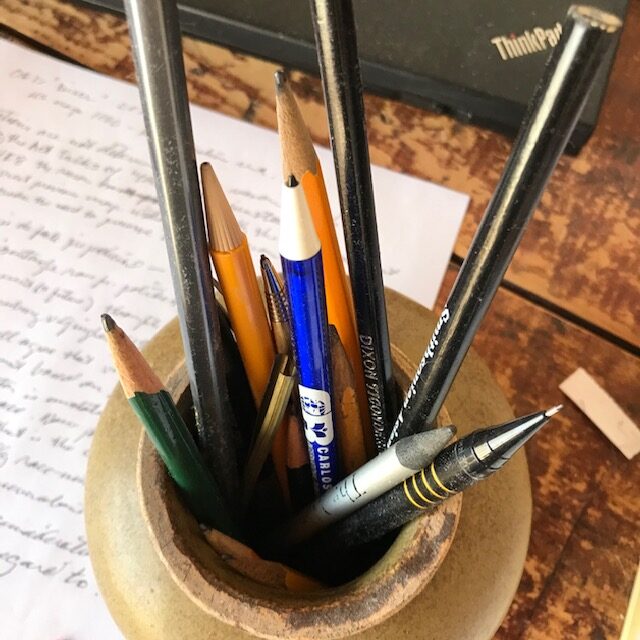
So, I begin this new series with an article on the obsolete pencil. Even if the pencil hasn’t disappeared completely from your life yet, it’s use has certainly diminished with the more general use of the ballpoint and the computer. Certainly, the number of people who actually write extensively with one of those yellow wooden sticks in this county must be nil. Yet, a few of us still remember that all our schoolwork was done with those No. 2 pencils.
In the computer age, the pencil must seem like the pen when printing was invented. In the prologue to the first book printed in English (it was printed in Brussels around 1473), the printer William Caxton, looking forward into the future age of printing, wrote, “In the wrytyng of the same my penne is worn, myn hande wery and not stedfast, myn eyen dimmed with overmoche lokyng on the whit paper.” You’ll notice that he is speaking of the pen, not the pencil. That’s because pencils didn’t exist.
The word “pencil” was used in Caxton’s day to mean a small, pointed painting brush, derived from the Latin word for small tail feathers of ducks (also the source of our word “penis.”). Two hundred years later, a pencil was a pointed piece of charcoal, graphite, silver, lead, even slate sometimes in a holder of some sort. Our pencils came two hundred years after that, a product of the industrial revolution which brought us the delights of engineering and mechanical ingenuity. Graphite was ground powder-fine, mixed with clay (sulphur, in cheaper pencils), washed, heated, put under great pressure, cast in a mold made of two grooved cedar wood sticks that were then glued together, face to face, to make the long strips of pencil that were cut to lengths and turned on a lathe for rounding.
It seems to me that two things happened when we transitioned away from the pencil. As a writer, the first that comes to mind is our loss of direct writing. By direct writing (even though writing is always with the use of an instrument and, so, indirect), I mean the illusion that what we write with a pencil is directly, even physically, connected to our thoughts, the illusion that the scrawling shapes on the paper we scribble are directly the expression of our thoughts and desires. Until I started writing on the computer, I wrote longhand on paper because the slowness of hand movements across the page seemed to match the progression of my thoughts. Typing was much too fast. I would type a sentence and then sit and wait for the formation of the next. With handwriting, I could write steadily, at the pace of my mental verbal formations.
That sense of connection to myself is now gone, mediated entirely by the algorithms of the computer. As a result, my mental habits have changed. I now pull readymade phrases out of the air to substitute for thinking in order to keep the rhythm of typing speed going. What I write no longer appears to me in the idiosyncratic shapes of my handwriting but in Calibri or Times New Roman or one of the standard typefaces that everyone writes in. What I think mirrors that change to a more public, appearance-oriented persona. I think and write what others say and write.
The other way in which the loss of the pencil affects and changes this culture which defines all of us is the transition from an understandable technology to a technology beyond our capacities. The mechanics of 19th-century technology was visible. You can take apart a typewriter or a Model A Ford and see how it works. You can even figure out how they got that thin rod of graphite down the middle of the wooden pencil. Electronic hardware will not reveal their workings, and software today is too lengthy to take apart unless you use other software. Thus, as a culture, we must accept what we are told, even when we try to express ourselves. Politically, that is not a culture that can promote democracy.
You may want to think on this unnecessary stuff about the pencil. During the era of the pencil, newspapers in this country did not refer to the president as our “leader” (führer in German). Today, we are all followers of our leader, whether we understand him or not, whether we like it or not.
Well, Mr. Yeh, I am pleased to say that I LOVE my pencils. How could I ever finish a crossword without an eraser? I especially love my Papermate pencils that I don’t have to sharpen even though I am going back and forth that they are enclosed in plastic. Also as a painter, where would I be without my pencil ‘sketches?’ Thanks for this article.
I used used a pencil today. They are a frequently used and common tool in my array of writing /drawing implements.
Very interesting! Also of note is how our handwriting has changed over the years since the pencil reigned supreme. Or mine at least. From the 1970s to 1990s my handwring was smaller, scrunched, precise. As the decades continued my handwriting is bigger, less concise or compact and unrecognizable from days of yore. My politics, however, have not changed unlike my optimism which has greatly diminished.
Fwiw. 😀