

Shouldn’t local residents, whose utility fees pay for solid waste and sewer facilities and their operation, decide if those facilities and services should be expanded? Or if Elephant Butte and T or C should “regionalize” those services?
Elephant Butte and Truth or Consequences have not been and probably won’t be transparent about expanding trash and sewer facilities and how they intend to share costs.
The majority of residents historically do not question their elected officials or hold them to account or expect them to communicate transparently and publicly.
Take, for instance, the utter lack of transparency and public input in the creation of T or C’s solid waste transfer station at 601 Nadyne Ct., which went online around 2012.
There was one public hearing at the city’s Planning & Zoning Commission level and then-City Manager Juan Fuentes shut down further public hearings.
T or C ignored the serious legal issues residents brought up at that hearing (around 2011):
– the proposed site was a government land grant limited to recreational use
– the building plans violated the city’s own ordinance requiring a 10-foot side setback between buildings
– there were no sewer lines to carry leachate from the trash that often contain heavy metals, PFAS or “forever chemicals,” VOC’s or volatile organic compounds, viruses and bacteria
– the leachate would go into the ground near the city’s sole well field, possibly polluting the groundwater from which the wells draw city water
– cost analysis of trucking trash versus applying for and building another local landfill was lacking
– cost analysis of where to truck the trash was lacking–then-City Manager Fuentes (with a passive city commission) gave an exclusive contract to the South Central Solid Waste Authority’s landfill in Las Cruces
There were public meetings at which residents could observe only. The purpose? Then-City Manager Juan Fuentes tried to get Sierra County, Elephant Butte and the Village of Williamsburg to agree to share the cost of building and operating the transfer station. He tried to “regionalize” the service, in other words.
The Village of Williamsburg was the only governmental entity that partially fulfilled Fuentes’ wish, and then only about a year after the facility was built and operating. Just as T or C had passed a law making all residents use T or C’s polycart trash service, so did Williamsburg. These captive payers, according to T or C’s commissioned Parkhill study done in 2025, are overpaying and thus subsidizing all the other money-losing services.
Polycart customers are over-paying about $500,000 a year. Dumpster collection loses about $200,000 a year. The transfer station or “collection center” loses about $320,000 a year. The recycling service loses about $260,000 a year.
The cost of trash trucks, with their finicky hydraulic-powered arms, have skyrocketed–about $500,000 a piece–and only last five years, according to the Parkhill study. That’s one of the reasons the T or C solid waste department’s budget has gone from about $1.2 million a year to $4.5 million this year.
For the past four years T or C Solid Waste Director Andy Alvarez has been asking the city commission to expand this money-pit operation that exploits its polycart captive payers. The city commission was and is on board and now so is current City Manager Gary Whitehead.
Alvarez pointed out about two years ago that PreReal is going to build 500 homes at the Turtleback Mountain Golf & Resort development in Elephant Butte and the city needs a bigger facility to handle the incoming.
Why doesn’t Elephant Butte build its own transfer station to handle its own trash, I asked Whitehead nearly a year ago. Whitehead said something like: We’re already taking in Elephant Butte’s trash.
Elephant Butte has contracted with a private company to collect polycarts, and those private-company trucks dump their trash at the T or C transfer station/collection center–which charges a money-losing rate that is covered by the polycart customers’ over-charge rate.
Whitehead, at the Oct. 14 city commission meeting said the city should build a second transfer station versus expanding the current facility, since reaching a certain trash volume comes with much more permitting requirements and oversight. It would be cheaper to have two smaller transfer stations.
The city commission was reviewing the projects on the Infrastructure Capital Improvements Project list before deciding what they would ask state legislators to fund with their capital outlay allotments. If a project is not on the ICIP, it doesn’t get capital outlay funding or any other state or federal agency’s funding or grants.
The thing is, the public hearings and resulting ICIP list that was adopted were held over March, April and May. The process was terrible, as usual, with the public lacking any information on what infrastructure improvements were needed and why. But even as recently as 2019 the city commission refused to add a spaceport visitors’ center to the list months after it was adopted, since it would make a further farce out of the ICIP/public hearing/public input process.
Now projects are added to the ICIP list in back rooms, with no public notice and without going before the city commission. N
Whitehead, in a recent interview, admitted he adds projects to the ICIP when he needs to, “because we can’t get federal or state funding unless it’s on the list,” and “I have problems I have to solve,” like the burgeoning solid waste volume and the solid waste vacuum system along Riverside Drive.
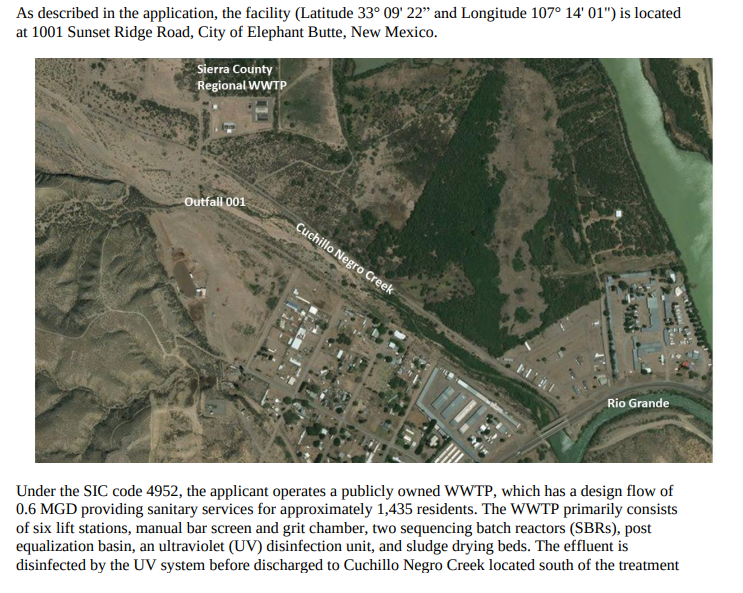
Whitehead, while examining the vacuum system over a year ago, looked across Cuchillo Creek at the “Sierra County Regional Wastewater Treatment Plant”–a name that presupposed regionalization for some reason. It has only ever serviced the City of Elephant Butte.
“That’s the solution,” he thought at the time. “Instead of spending $5 million to $6 million to put in a gravity feed system to replace the vac system, we could run it to Elephant Butte’s [wastewater treatment plant, which is at a lower elevation to the vac system and would circumvent having to build expensive pump stations].
Elephant Butte taking the 400 T or C customers’ solid waste currently on the vac system makes a lot of sense.
Regionalizing local trash collection does too–if cost analysis is done and equality in fees and the exploitation of polycart customers are solved.
Both could lower customers’ costs–but only if accurate cost analysis is done that apportions true costs and services to respective customers and governments.
If history is prologue, residents should have little confidence in a good vetting process being conducted behind closed doors. The people are groaning under the costs of the “new” hospital wing and Spaceport America.
And as described earlier, T or C has already unofficially regionalized its solid waste service, taking in tons more waste and not going in the red by overcharging T or C and Village of Williamsburg polycart customers.
I asked Whitehead if he didn’t think both plans should go to public hearings so residents from both cities could weigh in. No, he said. He thinks the city managers should work out the plans and details.
Local history also tells us that the residents will be fine with having zero input into the projects.