


Truth or Consequences City Manager Gary Whitehead is not Janus-faced, which cannot be said of its prior city managers over the last 20 years, who put on a false face that masked serious problems.
Whitehead’s forthrightness saves an enormous amount of time in getting the truth out to readers that would otherwise be delayed in sending out and waiting for responses on IPRAs and FOIAs. And if you don’t know the city’s wastewater treatment plant (WWTP) was under an administrative corrective order, for example, how would you know to request that document?
Not until Whitehead was hired near the end of February 2025, about a year and three months ago, could we know that the WWTP was under an administrative order.
The city commission said nothing about Arnie Castaneda’s sudden resignation as director of the city’s water and wastewater departments in January 2025, which can now be seen in a different light. The city commission has a long history of defenestration by resignation. “You may resign or we will fire you for cause–and that cause will then be public information.” That’s probably what happened, but we will never know, because the city commission prefers the false-front smiley face versus a frank revelation of incompetence or of serious problems.
But that attitude causes the people and journalists’ ability to do their job “informational injury,” as journalist Katie Phang’s recent victory in court makes clear in Phang v. Blanche. If our representatives hold secrets, it erases our duty and ability to be checks and balances on all three branches of government, which are below the people in democracy’s organizational chart.
Whitehead is breaking up the city’s culture of withholding information and it appears to be unconscious. “I try to tell the people what they need to know,” he told me in our WWTP question and answer session.
This attitude, that his primary duty is to the people, separates Whitehead from the raft of city managers whose first concern was cultivating city commissioners’ favor in order to keep their well-paying job and benefits.
So, although I did search the NMED and EPA websites for the administrative corrective order, I didn’t submit IPRAs and FOIAs when I couldn’t find it, because Whitehead was so willingly transparent.
Whitehead said that upon his hiring the city commission told him to address the administrative order (AO), which was issued by the EPA, not the NMED.
The people of T or C should know a few things in order to judge the seriousness of an EPA AO. First, New Mexico is only one of three states that does not have environmental supremacy, which means the feds don’t trust the state, at least without retaining administrative power to look over its work and take corrective action. The EPA has few staff and if it bothers to step in, it is serious. Second, the EPA can impose fines and penalties up to $120,000 a day per infraction until corrected.
So, no pressure on Whitehead upon his hiring.
The AO said the city had to:
–Fix the secondary clarifier weirs and launderers. According to Google AI, “Secondary clarifiers in wastewater treatment use weirs and launderers to skim off and collect the treated, clarified water. Weirs establish a consistent level to control the water’s flow rate, while launders act as the troughs that channel the water out of the tank for the next step.”
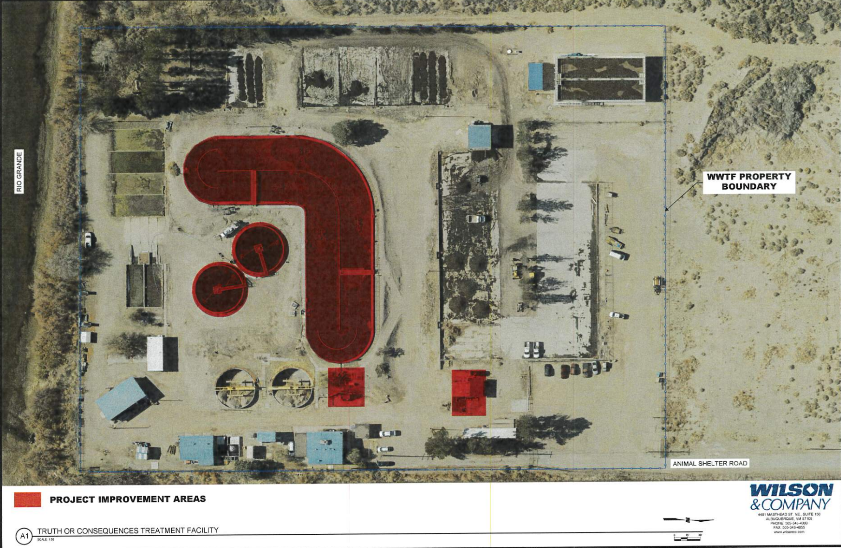
–Replace the aerator and improve the oxidation ditch.
According to the EPA, “An oxidation ditch is a large, oval-shaped ‘racetrack’ biological reactor used in a Wastewater Treatment Plant (WWTP) to break down organic matter. An aerator is the mechanical or diffused air device installed in the ditch that pumps oxygen into the water while continuously circulating it to keep the wastewater moving.”
–Fix the influent lift station and upgrade its headworks.
According to the EPA, “The influent lift station and headworks are the very first stops for raw sewage entering a wastewater treatment plant (WWTP). They work together to receive the incoming flow, lift it to an elevation that allows for gravity treatment, and remove large debris and grit to protect downstream equipment.”
–Replace the control system.
According to Google AI, “The control system in a Wastewater Treatment Plant (WWTP) automates and optimizes plant operations by continuously monitoring water quality, adjusting chemical dosages, and managing equipment like pumps and valves. It ensures the safe, efficient processing of wastewater while maintaining strict environmental compliance.”
Whitehead first had to find money to address any of these issues. Last legislative session, Governor Michelle Lujan Grisham granted the city $1 million to jump start the WWTP fixes. Whitehead switched engineering firms from Wilson & Company to Bohannan Huston. Wilson still retains its on-call status over the city’s water, but Bohannan is now the on-call engineer for wastewater, revealing Whitehead, unlike other city managers, gets in the weeds in questioning and choosing engineering firms and examines their thinking and work. This broke up Wilson & Company’s lock on the city for the last decade or so. Competition and responses to bids for water and wastewater projects have increased and better pricing has been the result, which saves the people money and helps keep rate increases down.
With money came plans that Whitehead could present to the EPA and NMED, who were convinced the city would address the problems as soon as it could, and the AO was lifted around the spring of 2025. But the EPA told Whitehead it would still require monthly reports from the city and would continue its rigorous yearly inspections.
Whitehead, in the recent question and answer with the Citizen, revealed the EPA reimposed the AO February 2025. The city missed two months of reports and the inspection showed that the WWTP generator wasn’t working.
The reports were submitted and the generator was fixed within three months, and the AO was lifted.
This second AO precipitated Whitehead to change the chain of command to get more oversight over department heads, since he couldn’t do it all, especially with over $50 million in current capital projects on the books. Bo Easley, previously director of the electric department, was made public works director. Whitehead credits Easley with getting the generator fixed quickly.
Whitehead and city staff have continued to search for funding to fix the issues listed in the first AO, which Whitehead thinks will cost about $4 million, but he admits the engineer thinks will cost about $5 million or more.
During the city commission’s June 24 meeting, a grant/loan for the WWTP fixes was on the agenda, which was officially accepted via resolution by that body, adding the biggest chunk of money so far.
Whitehead told the Citizen the grant knocked out the need to raise wastewater rates 15 percent, as recommended by a recent water and wastewater rate study. Water rates, instead of being tied to the Consumer Price Index, will probably need to be increased 5 percent a year. Rates have been increased as much as nearly 10 percent to 3 percent a year since 2019, and the city and the people need better predictability over expense and revenue, he said. Wastewater rates have gone up 5 percent a year since 2017, and that may be sufficient, given the funding gathered so far to fix the WWTP.
Whitehead ran down the WWTP funding on the books to address the first AO:
–General obligation bond money–the people approved a $3 million G.O. bond November 2024, $2 million of which can go to water and/or wastewater. It is being issued in four tranches of about $750,000 each. $50,000 from the second tranche will be used to pay for the weirs or headworks. $55,000 from the third tranche will be used for an unspecified part of the WWTP fix. When the fourth tranche is issued, $252,000 will be used for the cash match required as part of the grant/loan accepted by the city commission June 24.
–New Mexico Finance Authority Water Trust Board–
June 24 the city commission accepted a $2.277 million grant and agreed to borrow $252,000 from the NMFA and to match the loan amount with cash (see tranche four above).
–New Mexico Finance Authority Colonias Infrastructure Fund–in 2024 the city received a $274,860 grant, $30,540 loan and is required to pay a $30,540 cash match totalling $335,940 to fix the headworks.
Those three funding sources total $3.222 million.
Whitehead asked Governor Lujan Grisham for another $3 million in capital outlay during the latest legislative session, again, to fund the WWTP fixes, but it was not granted.
G.O. bond money may have to be tapped further, Whitehead said, but he thinks the wastewater rates may not have to be increased more than 5 percent to fund the WWTP fixes.
In any case, the people know the state of the plant, the EPA and NMED scrutiny the city is under and what money it has in hand to address those problems–an unprecedented amount of information that exposes the wastewater department’s foibles and fixes in an about-face of city culture. One face, not two, which should build public confidence in city management and its spending of public money.
💗Thank you.
Thank you for this report. It’s good to hear that Gary Whitehead is a refreshing voice for transparency.