
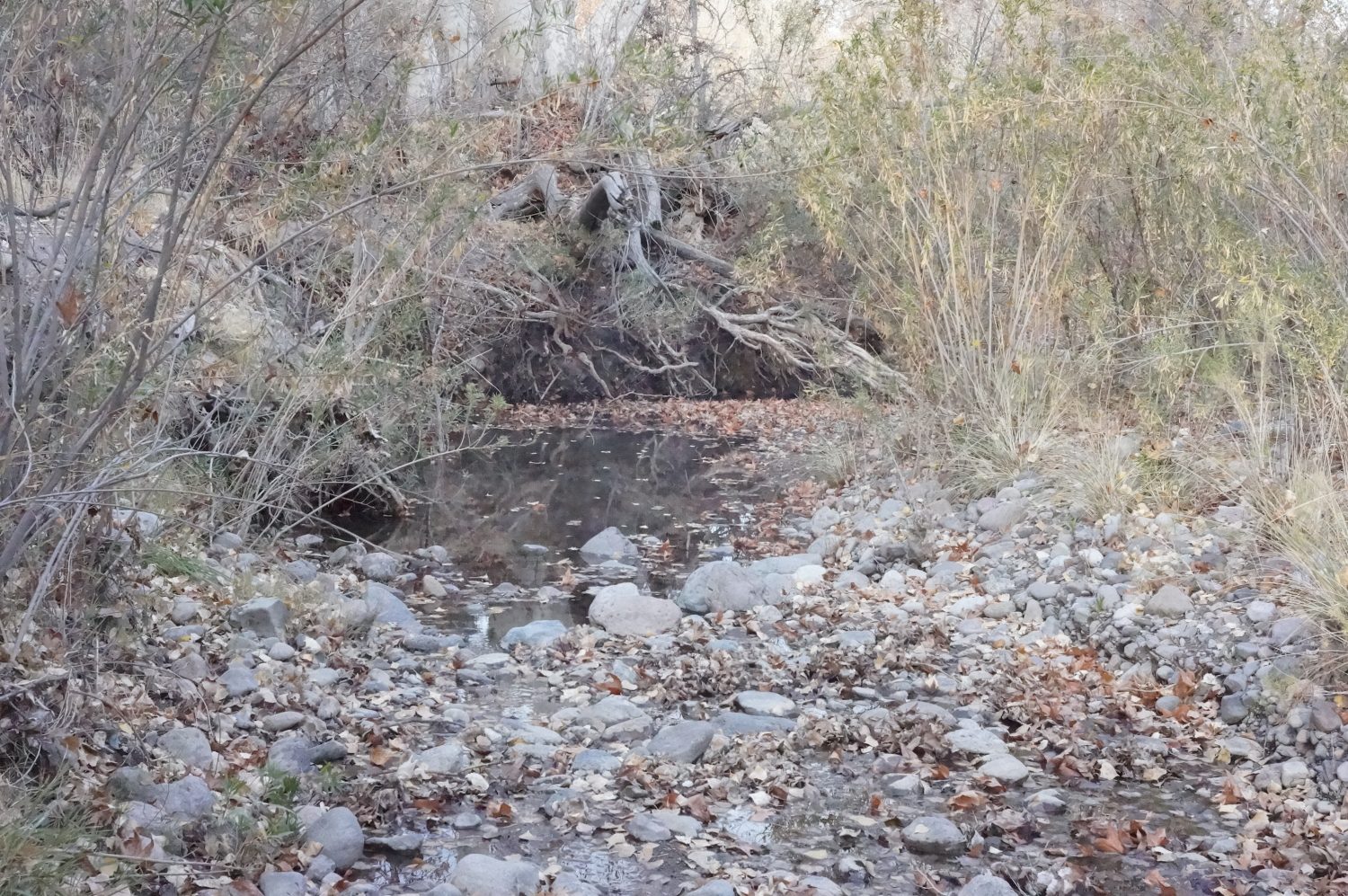

You may have noticed in the midst of the heat, that even though the monsoons came early this year, the land is pretty dry. The Rio Grande stopped running past Albuquerque quite a while ago. EBID will stop delivering its meager allotment of 4 inches per acre of water to its members today. Think of that, no more surface water for irrigation this year. Until Spring next year, all the millions of gallons of water used for irrigation will come from the ground, never to be replenished. If you haven’t yet noticed, we are in severe drought. In fact, southern New Mexico has been in drought for 26 years, even longer if you count the drought in the late 90s that broke for a year or so. Yet, we’re still living from day to day as we have always lived as if there were no crisis at all, as long as the tapwater keeps flowing, gardening, pressure washing, keeping our favorite trees alive, whatever.
But the crisis is not nature’s doing, which is what we seem to think when we talk about the super el niño or about the drought. It is our doing. The first complete study of water use in the whole Rio Grande/Rio Bravo basin from Colorado to Mexico shows that the long term cause of our crisis is our over-consumption: Richter, et al. “Overconsumption Gravely Threatens Water Security in the Binational Rio Grande-Rio Bravo Basin,” https://rdcu.be/fq52o. Click that link and take a look at our historical interaction with the arid climate of New Mexico. It’s a story of how to create a crisis.
So, we live in the desert but act as if we don’t. We don’t seem (at least by our actions) to appreciate this red, mineral rich, sculptured land. Instead, we act as if we imagine how nice it would be to sit in the cool shade of a tree looking across a fuzzy green vista.
Whatever the reasons for our over-consumption, it can’t go on. And, the first step back from the brink is the settlement of the Texas v. New Mexico and Colorado suit. See https://sierracountycitizen.org/what-you-need-to-know-june-5-2025-texas-v-new-mexico-and-colorado/; Supreme Court decides Texas v. NM – Sierra County Citizen; and Texas v. NM, going forward – Sierra County Citizen, where I discuss various aspects of the case in relation to Copper Flat Mine.
The settlement is an in-your-face moment of our over-consumption. For years, we — you and I — in the Lower Rio Grande Basin (which stretches from Elephant Butte to Texas and Mexico) have been using water that belongs to Texas and Mexico. I’m speaking not just about river water but groundwater, because along the river, groundwater is connected to the river flow. That means municipalities that don’t fix their leaking systems. It means commissions that push development, which always require more water both inherently in what is developed and in population growth. And that means us individually happily pursuing a life style that requires more and more water.
It all turns out to have been theft, grand larceny by the size of it. The settlement requires us to pay back that overuse and conduct our affairs (your and my water use in the future) so that we don’t do it again.
At this moment, we don’t know how to do that, but we do know that if we don’t do it, the penalties are set and severe. Major players are negotiating that now, and they have till October to agree to a plan. If the players don’t decide on something, the state must step in. The state’s only recourse is the control of water rights. So, right now, all water rights are up in the air.
Shortage of water is one crisis we are in. With the settlement of the suit, there is a shortage of water rights. That is a second crisis we will be living in. Ironically, while we were individually a major cause of these crises, individually we can’t solve the problem directly. Individually putting in water saving showers and toilets will do nothing to abate the structural crises we have created.
Only as citizens, as members of the social and political groups that underpin government and non-government associations, can we do something to engage with the structural problem.
If you are interested in what that might be like, I recommend you register to join a workshop on the consequences of the settlement with Nat Chakares, the General Counsel for the State Engineer, and Norm Gaume, former director of the Interstate Stream Commission. Go to this link: Workshop: Lower Rio Grande Settlement – Facts and Fictions – New Mexico Water Advocates (it’s the New Mexico Water Advocates’ website). There you will find a description of the workshop, information as to time and place, and a button to click in order to register to get a zoom link. Mark that on your calendars: July 23rd at 6:30 pm.
Let me give you one example of how unwittingly we use ever more water. In the good, old days, people opened up their adobe houses at night to cool them down and then closed them up to keep the heat out. Ranchers often had screened in porches where they slept at night. But then in the 30s, almost a hundred years ago, swamp coolers were being manufactured and sold in the southwest. That’s progress and development that directly translated into water consumption.
The next step you all know is refrigerated air conditioning, which is so ubiquitous now that many people don’t even know how to use a swamp cooler, just turning them on without opening a door or window to let the air flow through, undermining the whole evaporative principle of cooling.
I have heard people defend air conditioning over swamp coolers by saying that they save water. That is an advertising hype. Manufacturing air conditioners can make more money than manufacturing swamp coolers because there are more and more complicated parts to refrigeration; so, development-wise, air conditioning is a preferable advancement. But saving water is not one of the features of air conditioning. To make the electrical energy that runs refrigeration units, electric companies boil water away to make steam to run generators, and that process takes enormous amounts of water, nationally more water than anything else we do. Our use of energy constantly rises, but whether we generate electrical energy with coal, gas, oil, or nuclear, water is consumed and its use rises correspondingly.
In this story, it’s not our comfort that is driving the increased use of water. It’s the profit drive for technologically new products, the constant need for industrial expansion, and the investment in development which creates and conditions — often with a pretense of betterment — our need for increasing comfort. All along this progression, water and other natural resources are consumed in greater and greater quantities.
Max, the link you provided for registration to the workshop did not work for me.
I used https://nmwateradvocates.org then clicked on the registration link there.
Thanks for the info
Thank you, Deb. I fixed it. Stupid of me: the link I put in went to my email where i got notification of the workshop.
Overdevelopment.
We grow 30% more food than we consume in the United States. Globally its 19%.
Agriculture uses 80% of the fresh water in the United States. It has the lowest amount of economic output per unit of water used. Lower than manufacturing, lower than knowledge-work, and even lower than data centers.
The population of the U.S., Europe, and most of the world is declining as birthrates plummet below 2.1 births per woman. By 2050 it will decline globally as Africa follows suit, according to U.N. demographers.
So why would not pumping water for Agriculture bad? Max?
It’s counter-intuitive, but the best bang or the buck to promote a healthy river, marine life, and the broader landscape activity, is less water being used for Ag. Ripping up a field and covering the acreage with a data center, actually leaves more water in the ground and the rivers (70% of water in rivers comes from ground water seepage into the river, below the water-line of the river, not surface run-off).
Also, ground water is replaced. It snows or rains and soaks into the ground. That is how sub-terranean aquifers get charged and recharged. They are discharged by groundwater flows into rivers and creeks, and by pumping. 80% of pumping goes on crops, not to homes, factories, and businesses.
Some of what you say is true, but it is not true enough. The population of the US, for example, is not declining. The growth is declining. That is true also for the population of the world. That slowing of growth will eventually cause a decline if it continues, but quite a bit in the future. It doesn’t help our immediate crisis.
And, yes, groundwater is replenished, but very slowly, much, much slower than we deplete it, which is why the water table keeps going down. (Please take a look at the study I referenced on this.)
It is also true, as you say, that we “over-produce” food in the US, but that over-production is necessary because the market is completely inefficient in getting food into everyone’s stomachs. That is, given the complexities of where people live and how they are able to get food financially or through what stores where in relation to where different foods come from and how they need to be stored and where, we over-produce to have enough. I have no idea how much we need to over-produce, but I suspect it is substantial.
You are also right that agriculture uses the bulk of water in the US and that the economic benefit is less than other uses. However, one of the reasons the financial return of agricultural use of water is so low is that as a society, we demand cheap food. That is also one of the reasons for over-production. Food, air, water are not, or should not be, judged by their economic value in the same way as other commodities because they are essential. As an old saying goes: “sin oro se vive; sin agua se muere” (we can live without gold, but without water we die).
I don’t object to trying to figure out how much water agriculture actually needs, but I do object to the use of money as the only standard of measurement of value. There are other values, and those should be part of the consideration of how we use water.
One of the reasons agricultural water use is such a problem for us is because 150 years ago when gringos started coming to the southwest, they believed that with all the sunlight here, they needed only to irrigate to create an agricultural paradise.
We are the victims of their worship of development and economic value, which is why I think we should be cautious of continuing in the same vein. Data centers, for example, which you say use less water than agriculture. First, I don’t know how that comparison is made. Are you speaking of water used for cooling? Yes, since that water is recycled, it may not be very much. But data centers use a lot of electricity, which is entirely based on boiling away water. Are you counting that? In contrast, agriculture while using 80% of our water puts most of that back into the soil or river, i.e., it is recycled. Are you considering that in your comparison?
I am not saying that lessening water used in agriculture is a bad thing (it’s not a choice, even; it has to be done), but a lot of farmers going broke in a short time span is a bad thing for this small community. Our water crisis is real, both the shortage of water and the shortage of water rights, and it has been brought on by over a century of over-consumption. Thinking of new uses of water, like data centers because one believes that only the most profitable water use enterprises should be pursued, does not make much sense to me.
“In contrast, agriculture while using 80% of our water puts most of that back into the soil or river, i.e., it is recycled.”
64% of water used for irrigation in New Mexico makes it into the soil. The rest is evaporated away.
Electricity generation boils water, but is recaptured. Modern electric steam turbines are closed loop. They boil the water in steam to turn the turbine, capture the steam, cool it, and reuse it.
With Ag being the 80% user, restricting that use gets us the most water preservation in aquifers and streams.
You state that a data center is a new water use.
That need not be so, and in many cases is not so. In Utah, where one of the largest data centers in the country is being built in a desert valley, the water for the data center was secured by buying agricultural water rights from willing sellers, with those sellers land returning to the natural desert ecology. The ag users were using 100% of the water right and the data center is projected to use less than 100% of the water right.
So what is the end result in Utah? More acreage will be in a natural undeveloped, uncultivated state than after the data center is complete. The data center requires less developed acres than the agriculture did. Less water will be used. There will more natural habitat for all species, including humans.
Counter-intuitive.
We have to eat, but do we have to degrade the environment and ecology by producing more food than we need, often with massive public, direct cash subsidies to growers and more indirect subsidies such as Bureau of Reclamation water storage and distribution facilities?
Ag should not be a sacred-cow that is somehow more virtuous than any other land use. Do a factual analysis and let it compete with all other land use choices.
By the way, I forgot to mention that the 30% of over-production may not be enough to cushion under-production due to the drought and to unseasonal weather damage this year. I looked for Sig Silber’s report on the percent decline this year, but I couldn’t find it. Let this article and maps suffice: https://www.agweb.com/news/crops/crop-production/ive-never-seen-anything-devastating-toll-drought-grips-western-plains. Practically every crop is down, and that means also animal feed shortages going into next year.