
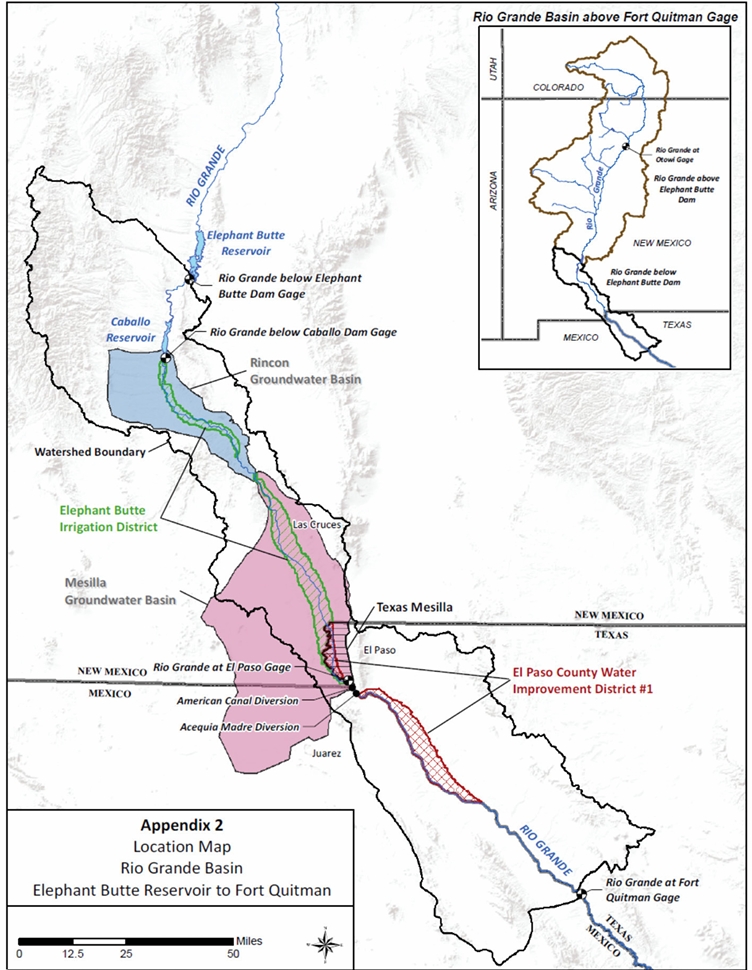

A couple of days ago, the Supreme Court approved the Special Master’s Fourth Interim Report on the case known as “No. 141 Original Texas v. New Mexico and Colorado.” The Special Master Judge D. Brooks Smith, the third Special Master appointed to this case, presented and argued for approval of the Consent Decree (the second in this case) by which all the parties settled their differences. See https://www.ca3.uscourts.gov/sites/ca3/files/fourth_interim_report_020626.pdf.
Judge Smith seems to be a history buff, commenting in an aside that water disputes originated over 8,000 years ago when river water was first diverted for irrigation and that 4,500 years ago one of the earliest know wars in human history was fought over water. His report gives an orderly narration of the dispute and its resolution.
Texas, joined by the federal government, sued New Mexico in 2013, accusing it of allowing groundwater pumping near the Rio Grande between Elephant Butte Dam and El Paso that undermined Texas’s portion of the river water under the 1938 Rio Grande Compact agreement between Colorado, New Mexico, and Texas, a compact which more than a contractual agreement was approved by Congress and thus had the force of federal law.
The Texas suit came while an earlier suit by New Mexico was still pending. In 2008, EBID (Elephant Butte Irrigation District) settled a decades long conflict with neighboring EP1 (El Paso County Water Improvement District, No. 1) over how to divide river water below Elephant Butte Dam. That settlement brought on New Mexico’s suit in 2011 against EBID and EP1 and also the US alleging that the settlement violated the Compact. The US is involved because the Bureau of Reclamation originally built Elephant Butte dam to provide water for EBID and EP1, it manages the release of water from Elephant Butte Reservoir, and it has treaty commitments further downstream to Mexico. Furthermore, since the river is interstate, the federal government has jurisdiction.
The Texas suit sort of rolled all the disputes into one, since at issue was the interpretation of the original Compact, which, in fact, does not specify how much water should cross the state line into Texas, something which at the time was not technologically practicable.
The solution in the present Consent Decree turns upon what is called the “D2” time period, running from the beginning of 1951 to the end of 1978. All the parties (the US, New Mexico, Texas, Colorado) and all the organizations involved as friends of the court (the affected entities such a EBID, EP1, the City of Las Cruces, the New Mexico Pecan Growers Association, the Southern Rio Grande Diversified Crop Growers Association, etc.) agree that the water situation of those 27 years represents a norm for the river and that that norm should be the standard in apportionment of water. Accepting D2 means that New Mexico must deliver to Texas (at the newly establish El Paso Gage) 790,000 acre-feet of water every year (excluding consideration of water the US must deliver to Mexico).
That water is kept at Elephant Butte Reservoir (and released through Caballo Dam). That water is apportioned to EBID and EP1 on a 57%/43% basis, that being the proportion of irrigated acreage of the two entities. Water released at Caballo Dam minus water passing the El Paso Gage gives the EBID portion (and also a measure of how much groundwater pumping affects the river flow and thus the delivery to Texas).
Although the Consent Decree does not specifically say that New Mexico has been violating the D2 norm for decades (there’s no assignment of guilt since the parties have also asked for a dismissal of the suit), the Decree allows New Mexico time to come into alignment with the new standard before under-delivery begins to result in consequences.
The Associated Press reports that “New Mexico must reduce annual groundwater depletions by 18,200 acre-feet, or about 5.9 billion gallons (22.3 billion liters) within the next 10 years.” That apparently represents a 5% to 7% reduction in groundwater use in our basin. See https://www.krwg.org/regional/2026-05-29/us-supreme-court-settles-long-running-water-dispute-over-dwindling-rio-grande. On a pro rata basis, that is a permanent reduction of 1,820 acre-feet a year.
It remains to be seen whether the New Mexico will allow a mining permit at Copper Flat Mine which will use over 2,000 acre-feet a year (water that has never been used before) when it must enforced cut-backs, during a drought when cut-backs will be painful, and faced with continuing, if not increasing, climate change reductions of both surface and ground waters.