

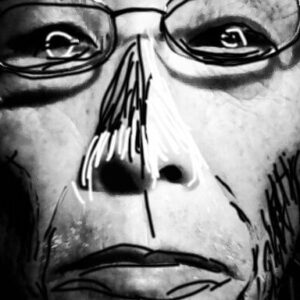
Arbeit macht frei
It is true what they say,
America sent its work out,
lost its appetite for work.
It wheezes from soft comfort,
lolls in purchased charm.
But look who’s saying it:
A self-indulgent elder with small, pink hands
which never had to work,
calloused by the leather grip
of a putting iron.
A robotic sperm-machine madly shouting
“I’m building the future,”
as if the future were made of shuffled papers
and building, the hard task of signing checks.
A self-made intellectual,
whose greatest pride lies
in having escaped the struggle,
bemoaning America has no hard work to do.
We have to swallow the Kool-Aid pill,
they say.
Rid ourselves of foreign labor,
at home and abroad;
their lower wages will be ours.
Raise the taxes, they say,
so we will be able to work.
Up the costs of everything,
so we will be able to work.
Crush the economy, they say,
so we will be able to work.
Greatness will be ours again, they say,
freedom is nothing but work.
Note on the title:
The poem’s German title means “Work makes you free.” During a demonstration against Covid quarantine in 2020, someone carried a sign with this German saying and was widely condemned for referring to the motto on the gates of the notorious Nazi death camp, Auschwitz. I use this title not to compare the present American administration with National Socialism. Everything that happens has its own distinctive and unique characteristics and once the complex causes of something happening pass into history, they are not met with again. You can’t go back in time. But all the same, everything we know about anything comes to us out of the past. There is no learning without history. And it is in the interests of history that I use this Nazi motto, because I was struck by how that discussion in 2020 showed how little we know about Nazi history, showed that other than a few click terms like “holocaust” or “Auschwitz,” the whole disheartening history of Germany in the 20s and 30s and 40s has been reduced to name calling.
Arbeit macht frei should not be associated with Auschwitz without understanding that its use follows a path the German people took from a recognizable idea through power politics, jingoistic thinking, war, and resource scarcity to mass extermination. The motto was first used long before the war in 1933 at the forced labor camp Oranienburg, just outside Berlin, the first of its kind in the large eastern state of Prussia. It was created by the SA (Sturmabteilung, assault battalion or storm troopers), the paramilitary group who pushed Hitler into national prominence by their open attacks on political opponents through the 1920s and early 1930s. They were known as “brown shirts” for their semi-military uniforms. They were the street fighters who smashed Jewish stores and openly attacked political gatherings of left-wing groups. They might be comparable to our Oath Keepers, Three Percenters, or Proud Boys, but centralized and functioning in an entirely different setting. The Oranienburg Forced Labor Camp housed the “undesirables” who were sent there by local jurisdictions who convicted them for various “crimes,” demonstrating in public, fighting, etc. Inmates, mostly political prisoners belonging to the Social Democratic Party or the Communist Party served hard labor, and some then were released.
In the summer of 1934, however, in a massive political purge called The Night of the Long Knives, Hitler, using his other paramilitary group the SS (Schutzstaffel, security squadron), killed close to 100 of SA’s leaders and disbanded the SA. SA leader Ernst Roehm not only had challenged Hitler’s popularity, but the SA had planned to replace the German Army with its own forces. The SA had asked for access to heavy military weapons, and in fact their forces outnumbered the Army. The SS, originally Hitler’s personal bodyguards but by then a force of several hundred thousand including the federal police, formed part of the government. The purge marked Hitler’s transition from a revolutionary outsider to the country’s political leader.
The SS took over the Oranienburg camp in 1936, renamed it, and rebuilt it architecturally as a visible statement of its world view: state security above all. The new Sachsenhausen Concentration camp kept the motto Arbeit macht frei. As the regime tightened and centralized its ideological stance and governmental structures before the war, Sachsenhausen served many purposes. It, of course, housed its ideological opponents, former members of parliament, religious dissenters such as Jehovah Witnesses or German Protestants such as Martin Niemoeller, the Lutheran pastor famous after the war for his statement “First they came for socialists, and I did not speak out.” Non-Aryan peoples were interned there: Jews, of course, but also Gypsies, Blacks, Asians, mixed race children. Deviants of all kinds, homosexuals, beggars, the anti-social. There was another sign on freedom in Sachsenhausen. It said, “There is a path to freedom, and its milestones are called obedience, diligence, honesty, order, cleanliness, sobriety, honesty, truthfulness, sense of sacrifice and love of nation.” How could you doubt the good that these camps served?
When the war started, the camp took on prisoners of war; some 10,000 Russians prisoners were killed here by what was known as the “neck shot method.” Prisoners were taken to a room with music playing to be weighed and their height measured against a wall. A sliding door opened in the wall at head level, and the prisoner was shot in the back of the neck. But this proved too time-consuming, and mass shootings in mass graves were instituted.
There were also prisoners from the occupied countries, again Jews and political prisoners. Sachsenhausen was where right-wing activists captured in occupied territories were indoctrinated to become Nazi propagandists in their home country: Stepan Bandera, much admired in Ukraine today as a national hero, trained here. Medical experiments took place here. It was the center of counterfeiting British and American money. Sachsenhausen became the training ground for SS officers (who administered the forty or so thousand camps that Germans eventually operated). When push came to shove during the war and food and supplies became national problems, the pragmatic solution of gas chambers and gas vans were tried here first before their introduction at Auschwitz. In 1944, Himmler (the SS leader, and thus head of national security) ordered everyone at Sachsenhausen killed.
The camps were always a balance between the need for workers and the cost to keep them alive. One wonders in our history what would have happened in the camps we created in the same era for Americans of Japanese descent if the war had gone badly for us or food became scarce. What did our Vice President say a few months ago? In speaking of the theological concept of ordo amoris (the structure of Christian love), he insisted that it is only natural that one prioritizes (what a word to use here) one’s family above strangers. Pope Francis rebuked him, but there are many people who also think that prioritization of love is natural, understandable, and right.
Fairly early on in the evolution of concentration camps, the saying Arbeit macht frei migrated to Dachau, another early forced labor camp for political dissidents, and after the occupation of Czechoslovakia and Poland it was used at Theresienstadt and Auschwitz. At Theresienstadt the motto served, it seems, a propaganda purpose. Although Theresienstadt was used as a labor camp incarcerating Jews from Eastern Europe in 1941, in the 1942 Wannsee Conference, where the regime decided on the genocide of all European Jews, Theresienstadt was presented as a holding place for elderly Jews, disabled Jews who had earned military distinction in the First World War, and well-known Jews from the cultural world, a spa. In fact, Theresienstadt held Jews from Austria, Germany, and Czechoslovakia for work, and principally, was a transit hub for the death camps. Over 30,000 people died there from malnutrition and disease.
At Auschwitz, where over a million Jews were killed, Arbeit macht frei sounds like brutally cruel humor. The phrase has come a long way from the initial expression of a work ethic so familiar to ourselves. While that path was prodded and formed by economic conditions unique to Germany after the loss of the First World War, by the rise of nationalism among ethnic minorities in the collapse of the Austro-Hungarian Empire, by the sense of European superiority, by a thousand year history of racism, and a callous familiarity with continuous military conflict among European nations, the logic of that path, the jingoistic political thought that justified its every turn until it arrived at Auschwitz, should be learned and recognized by everyone if we do not want to create new growth in new soil.
A brilliant review, Max. Thank you as always.