
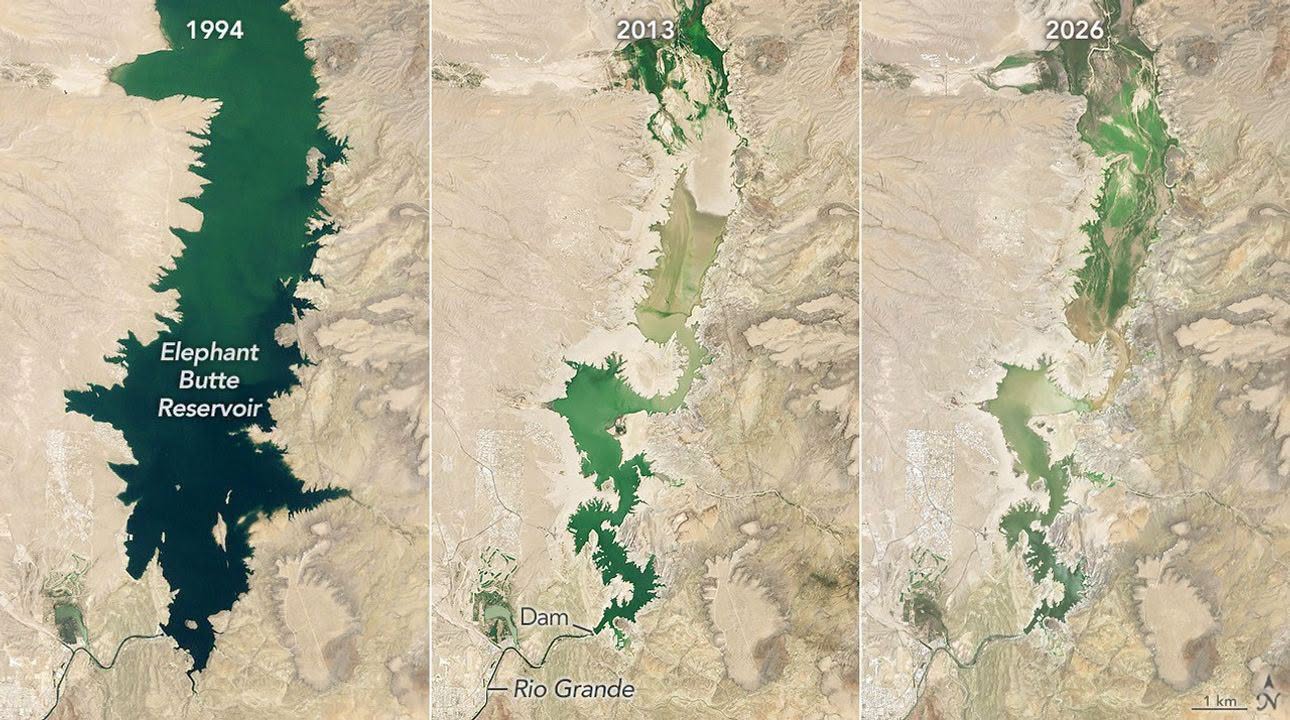

In 1994 the Elephant Butte Reservoir was almost full. Now it is at 1.4-percent capacity, the basis of the emergency declaration passed by the Truth or Consequences City Commission at their Aug. 28 meeting.
T or C’s emergency declaration follows Elephant Butte’s and Sierra County’s, the government officials coordinating and cooperating behind closed doors. It is hoped the three emergency declarations will get the attention and funding of the state’s Department of Homeland Security and Emergency Management.
The DHSEM doesn’t open its coffers unless the local entity demonstrates the damage is clearly beyond its resources and budget. State help typically starts at $750,000.
Federal Emergency Management Agency help is more formulaic. More than $4 million in damage must be demonstrated before giving federal aid is considered.
The emergency declaration emphasizes economic loss due to loss of visitors and tourists. We’ll see if FEMA or NMDHSEM considers a drop in gross receipts tax revenue and lodgers’ tax revenue due to low lake levels as an emergency.
The state laws governing state aid run from 12-10-1 through 12-10-21.
The aid to be given is defined in 12-10-4, and it does not match the aid requested in the T or C emergency declaration:
12-10-4
(3) provide those resources and services necessary to avoid or minimize economic or physical harm until a situation becomes stabilized and again under local self-support and control, including the provision, on a temporary, emergency basis, of lodging, sheltering, health care, food, transportation or shipping necessary to protect lives or public property; or for any other action necessary to protect the public health, safety and welfare;
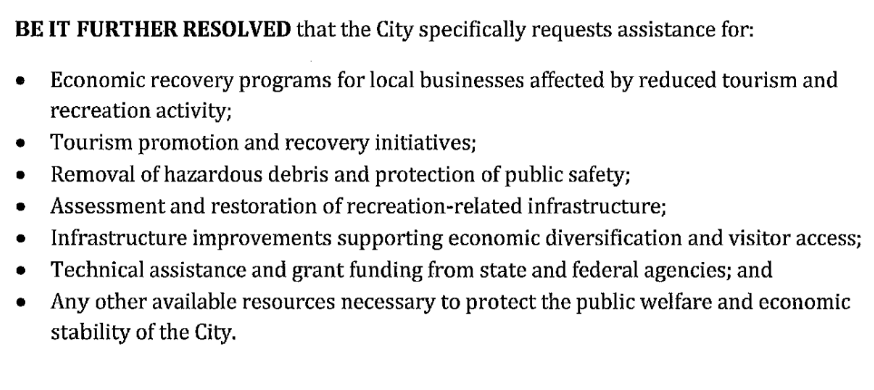
In its emergency resolution, the city is asking for aid that doesn’t match the state emergency provisions:
If the local governments’ use the stats presented by County Manager Amber Vaughn to the T or C city commission, it is unlikely that state or federal funds or other aid is given. Applications are due to NMDHSEM within 30 days after an emergency resolution is passed by the local government.
Vaughn presented figures and graphs for gross receipts tax revenue and lodgers’ tax revenue for each of the local governmental entities since 2023.
T or C’s “tourism sensitive” GRT revenue from “ accommodation, food, retail, arts/entertainment” industries is down 4 percent from 2023. Sierra County’s GRT has risen. Elephant Butte’s has risen too–nearly 11 percent from 2023. These stats do not support emergency-level economic damage.
Lodgers’ tax revenue in Sierra County has also increased, maybe due to Ted Turner’s Reserves, but T or C’s is down from 2023, as is Elephant Butte’s. Vaughn only gives bar graphs, not figures. She said T or C’s lodgers’ tax revenue is down 14 percent from 2024, but it is unfair to use that banner year in a comparison. Every local government’s GRT and LT revenue was way up due to massive construction projects in the area. Lodgers’ tax revenue is down in T or C and Elephant from 2023, but not by much.
It’s somewhat bad, but is it an emergency? Will the state see this as crying wolf? And any FEMA money seems highly unlikely. I see nothing that approaches $4 million in damage that would trigger opening FEMA coffers.
My reading of the excerpted statute doesn’t exclude the kind of relief being requested by the city and county, but rather, gives examples of the kinds of relief that are included, among others. It seems we ought to broaden the data being included: what, if any, impact is the lake disaster having on property values? Are home purchases down? Are prices for basic goods increasing as indexed against neighboring counties? How long will these losses extend into the future? For example, will people come back to lake recreation? Or will they find other recreational pursuits?
Interesting. My reading of the state laws on disasters and 12-10-4 in particular is “temporary” support, including economic, such as temporary shelter, food, blankets, etc. What the city is asking for is long-term support. And the “disaster” is not the result of a sudden storm or flood, but a slow-moving series of events: 20-year drought, the May U.S. Supreme Court ruling that said New Mexico must deliver over 18,000 MORE acre feet a year in water to Texas. If this is accepted as a disaster, any community along the Rio Grande would qualify and the people’s emergency funds will be emptied out on promoting tourism and recreation and training and technical assistance, etc. This sounds like the state’s Economic Development Department’s job, not emergency management.
I would agree with Kathleen on this point. We loved for many years in Western North Carolina. After seeing the devastation from Hurricane Helene, it brings home what “disaster relief” really means. Our sad little empty is a travesty, not a disaster.
See Reserved Federal Right by Gary King (a different GK, not the politician), 1982, federal courts: We do not build this stuff only to not use it, that reservoir was built to contain water. You can use this legal concept to ‘force’ them to return water to the Reservoir. It has been used successfully in the courts.
(My name is not a pseudonym).