
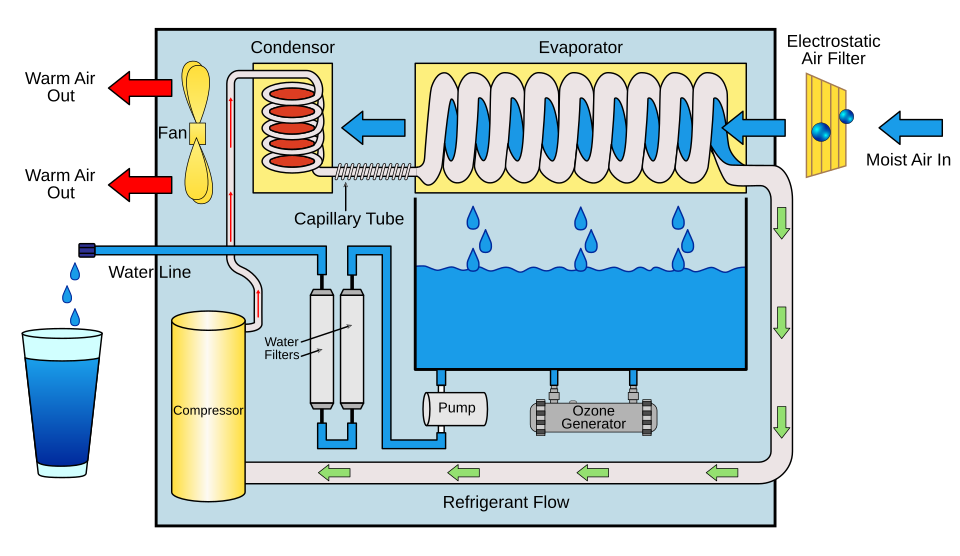

Green Data, whose proposals to build data centers in Socorro and Sierra counties have been blocked by moratoriums, is renewing its efforts in Sierra County. The company aims to resolve previous objections by keeping the new project small, at or near Spaceport America, relying on solar energy and batteries, and extracting water for coolant directly from the air.
Green Data founder and chief executive officer Jason Bak, PreReal Investments founder and chief executive officer James Prendamano, Truth or Consequences Mayor Rolf Hechler, Truth or Consequences City Manager Gary Whitehead and Elephant Butte Mayor Richard Holcomb and others attended a closed, unannounced meeting August 19 to discuss the new proposal.
Sierra County Commission Chairman James Paxon, who joined the group by phone, said because no other members of the governing bodies of the county or municipalities participated, there were no quorums and the meeting was not subject to state open-meetings rules. Nevertheless, Holcomb recorded the meeting and used a program to produce a written transcript and summary that were obtained by Project Consequences, which opposes new data centers.
The error-laden transcript does not identify the speakers, but some can be determined by the subjects or names mentioned by other speakers. It begins with “Speaker 1” (presumably Bak) talking about two proposed buildings of 11,000 square feet each (about the size of 10 small houses) and each using about 5 megawatts of electricity per hour (about what is used by 2,500 to 5,000 residences, requiring 20 to 25 acres of solar collectors) and about 15,000 gallons of water (about what a single household would use in a year) in a closed-loop system that would not need to be refilled for years. The water would not come from aquifers or surface flows, but would be extracted from the air by atmospheric water generation devices. A single unit could produce 125,000 gallons a year, so the extra water could be used by the Spaceport for other purposes, including fuel.
“We don’t believe it is science fiction,” said another speaker on the transcript. “Generation one, which is basically a large dehumidifier … is already being utilized elsewhere around the world.” Skeptics question if the units could work in arid climates, but the speaker said the units don’t have to operate year-round and could be limited to the monsoon season. Even more efficient atmospheric water generation devices are being developed for the military, a speaker said. He said Green Data, a Canadian firm, is partnered with an Australian company aiming to set up a factory for such devices in Santa Teresa where Project Jupiter is located
Asked how often the units need new water, the speaker said they just need to be topped off regularly and flushed only every 10 Ito 15 years. The flushed water doesn’t contain “forever” chemicals but only “food grade” ones. “The reason why you wouldn’t want to drink (it) is there’s a lot of plastic. … There’s metal, there’s lead. … There’s actually other things that is, you know, incredibly below any environmental requirements. So the whole point is that it’s not like a radiator fluid.”
Asked how the proposed data center would compare to the Jupiter Project, underway in Doña Ana County, Speaker 1 (presumably Bak) said it would be less than one or two percent of the size. On July 14, the Sierra County Commission, following the lead of Socorro County, approved an 18-month moratorium on large data centers on private land. But that would not include smaller data centers on state land, like Spaceport America, though locating it there would need approval of the county commission, the State Land Office and the New Mexico Spaceport Authority. Another speaker (presumably Prendamano) said that to be successful, the Spaceport must be open to all sorts of proposals, whether data centers or “spin launches,” and to move quickly to take advantage of opportunities. The Spaceport has “been working with these guys for five years … and that’s not how business works. It’s not the speed of business,” he said. “The state land should have nothing to do with Sierra County. But you’re basing your decision on Sierra County.”
President Donald Trump has been a proponent of artificial intelligence and data centers since meeting with OpenAI founder and CEO Sam Altman in 2019, according to the recent book Regime Change. Trump, who has become an investor in AI and data centers, recently mocked data center opponents on his Truth Social site by saying they are choosing to be “backwards and poor” while those welcoming them will see lower taxes and new jobs. China, for instance, “could not be happier” with opposition to data centers in the United States. Those at the August 19 discussion were concerned how the November election might affect Sierra County’s willingness to accept a new data center. The participants leaned toward dealing with state Sen. Crystal Diamond Brantley rather than state Rep. Rebeca Dow because Dow must tread carefully as she faces re-election while Brantley does not.
The conversation kept looping back to the perceived opposition to data centers, with one speaker calling it “an international funded effort of disinformation on social media. … I’d love for someone to do a study and find out (about) the people who show up and speak out. What groups are they connected to? How are they funded? Are any of these people influencers that are paid by outside groups? What are the groups? Let’s start doing some IPRA (Inspection of Public Records Act) and do studies on where the opposition is coming from.” Another speaker said the local opposition is led by what he called “cane” or “cain” people for “people against virtually everything.” (The acronym would seem to be “cave.”)
we the people have said, many times & in many ways how much we DONT WANT DATA CENTERS & yet we are doubted, & the attempts at gaslighting & bamboozlement continue… this fight is obviously huge & we are a vulnerable community~ all we really have is our solidarity… the idea of taking water from the air is preposterous~ if there is any water in the air, we need it there…
I don’t think characterizing the opposition as cave people is helpful. Thanks city leaders. Objectivity is a quality of leadership we need, and decisions made on fact finding and rigor. Pro AND cons, extending analysis to the impact on the future and consequences of the present. It’s not about taking sides, it’s about due diligence and making a true discernment about what is a good decision. So far it seems our leaders are only listening to the vendor. Creating water from the air is not a net zero energy expenditure even if it is feasible.
The holding of such secret (behind closed doors) meeting(s) that could effect the public interest by trying to influence elected officials is very concerning. The real question is who spearheaded or organized such meeting(s) needs to be exposed so that residents can make informed decisions for future projects and elections.
Tom, thank you so much for covering this meeting and putting the proposed project into the public record. I’m offering two technical corrections in the spirit of keeping the numbers clean, not to dispute the larger reporting.
First, the article says “5,000 megawatts of electricity per hour.” That appears to be a unit error worth checking against the recording. A 5,000-megawatt load is 5 gigawatts—one thousand times larger than 5 megawatts. The residential comparison appears consistent with 5,000 kilowatts, or 5 MW. Power is normally expressed in megawatts; at full load, a 5-MW facility would use about 5 megawatt-hours of electricity in an hour. I majored in electronics in college, so I want that to be accurate.
Second, I would attribute the 125,000-gallon figure more explicitly as the proponents’ site-specific estimate rather than an established annual WaterCube output. Genesis Systems rates its WC-1000 at 1,000+ gallons per day at 80°F and 60% relative humidity, and says actual production varies with local temperature and humidity. The illustration accompanying this article is a generic Wikipedia diagram of an atmospheric-water-generator process, not a Green Data/Genesis design document or a Spaceport performance study. It shows the general concept, but it cannot establish the stated annual output, electricity use, or net water balance. What is still needed is a Spaceport-specific annual model: weather assumptions, dry-season output, electricity required, and projected net water balance.
Third, I am one of the 600 subscribers to Mr. Prendamano’s podcast and have listened to him extensively, so I’m very familiar with his voice and confident in the passages I would identify as his. If speaker attribution or timestamps would help, I’m happy to discuss them.
I appreciate the reporting. A few words of precision here will help readers evaluate the proposal fairly.
Melanie: You are right regarding 5 megawatts vs 5,000. It was my mistake. I have changed it in the copy. As for the output of atmospheric water generation devices, the 125,000 gallons a year was the developer’s estimate, so I will let it stand for now. I will send you an email about other things you mentioned. Thank you again. – Tom Sharpe
A simple google will show there are a number of different types of data centers. No one has explained to me why on earth it is needed out there in the middle of nowhere , literally. And what it will be designed to do. Not to mention how I will help the people of New Mexico in particular , those in Sierra county.
There’s a reason the Feds always required at least three bids on a project like putting in a data center. At present, there are three main data center working types, a swamp cooler type (uses lots of water), an A/C type (uses lots of electricity) and the type that sucks water out of the air humidity (you have to have a reasonable amount of humidity – we don’t). There is another that’s pretty new and uses methods which use little water OR electricity. The last is more suitable to us, I think, but apparently it hasn’t even been explored. The moratorium would give everyone an opportunity to evaluate the types, location, etc.. And yes, people in Sierra County are intelligent enough to do that. I think data centers are inevitable but there’s no reason any has to be here and if any is, it needs to be prepared for a lot better than has been so far. How about a committee with some of our retired or current, water, electrical, electronic, AI, environmental scientists and legal experts plus other interested parties, to research and evaluate any proposal and it’s company. We in Sierra County are competent, educated and savvy enough to be involved in the decision making and we are the ones most concerned with Sierra .County for the future.
I find it odd that we are busily discussing the merits of different data centers without any idea of what they are going to be (specifically) designed to do and why there is interested locating them in these specific locations.