
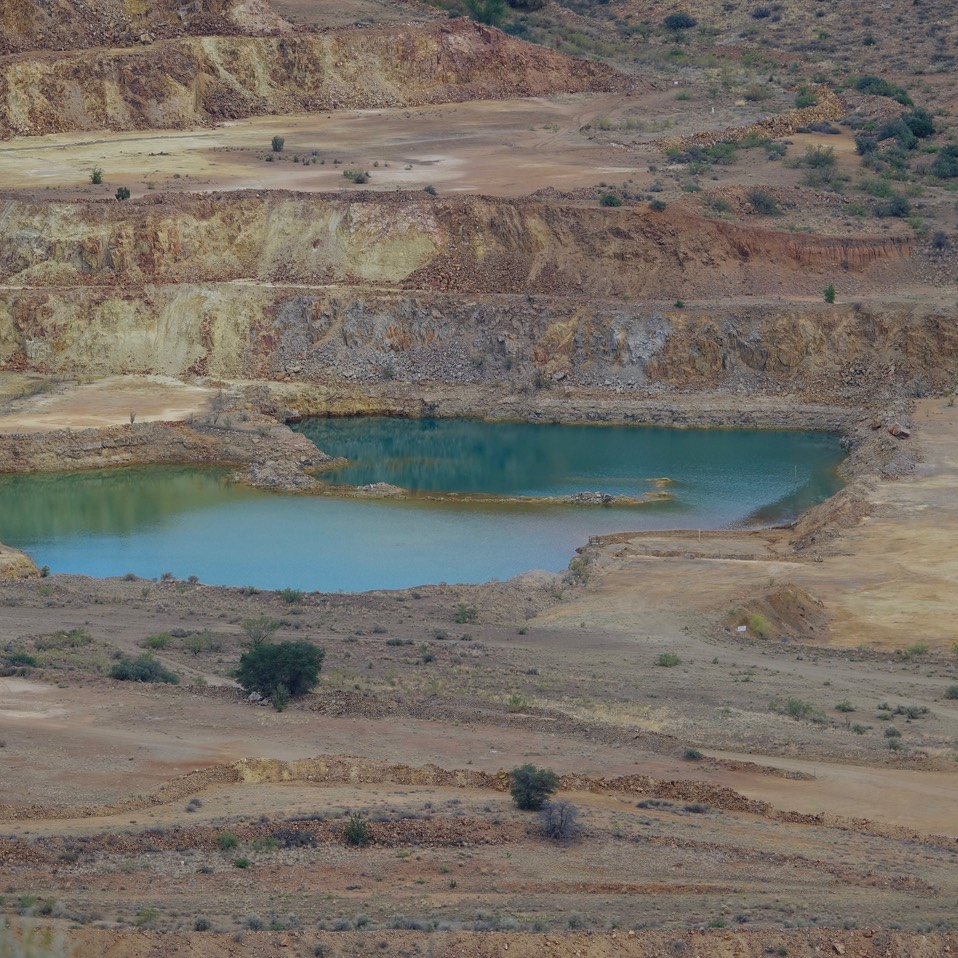

1. Copper Flat Mine is a low-grade ore mine. In 1982 it operated for 3 or 4 months, and it mined ore that averaged 0.42% copper. Some of the best ore was mined by tunneling to the richest spots. What is at Copper Flat now is a somewhat lower grade ore. High grade ore (generally with ore concentration greater than 1.0%) is still available in the US, and some mines have ore that is 5% copper. This means that mining at Copper Flat moves more earth, raises more dust, produces more waste rock, produces more tailings, uses more water, consumes more energy, takes more workers and equipment, and costs more to operate than most other copper mines in the country. The new proposal to use a filtered “dry” stack tailings saves some water but uses roughly 1/3 more electricity (amounting to an annual electrical bill of about $25 million). Even with the water savings, there is barely enough water to supply a mine 1/3 the size the miners plan. Processing only 10,000 tons of ore a day instead of 30,000 tons means 1/3 less income; so, mining may not be profitable.
2. Copper prices fluctuate greatly not only because of demand but because most of it is privately stored in order to control the market prices. Copper Flat Mine closed in 1982 because of a steep drop in prices that did not recover until ten years later. The fully operative mine, turnkey ready, was for sale for 5 years without takers before it was dismantled. The owners could not pay the 20% interest on the loan taken to construct the mine, said the processing manager in a sworn affidavit.
3. At the last publicly available accounting, Themac Resources had a loan debt of $189 million (Canadian dollars) (including accruing unpaid interest of 20%). Its working capital deficiency (Assets [including mine property and minerals] – Liabilities) was $97 million Canadian dollars in the red (about $71 million US dollars). That was in March, 2025, before the company became private; so, its finances are no longer public.
4. Because of the high cost of operation, the high cost of loans, and the normally high fluctuations of copper prices, it is most unlikely that operations at the mine can be continuous. Therefore, when the mine says it plans to operate 10 to 15 years. It means operating years, not calendar years. The mine can operate intermittently for decades, but only if it can generate enough profit as it goes to pay off its debts in a timely manner. All that time, the pollution never gets cleaned up.
5. Many people who think that the mine will bring jobs to Sierra County don’t seem to understand mining jobs. They think jobs that last 10 or 15 years a benefit for the county. But because of copper price fluctuations, mining jobs at a marginal mine last only a few months: there are as many firings as there are jobs. If you think 100 jobs will be good for the county, then you must also think 100 firings are good for the county, because that’s what intermittent jobs mean. We are likely to have decades of net-zero job “increases” in the county with the accompanying social disruptions of inflows and outflows of workers and personal financial hardships that go with them.
6. Many people who talk about the large number of jobs the county will get also often confuse operational years and calendar years. When economists speak of economic development, they habitually think of annual inflows and outflows, of annual budgeting, etc, The mine has adopted the same language in speaking of jobs. When they say “jobs,” they sometimes mean “job years.” One job year is a person working for one year. That means that 300 jobs for 10 years might be described as 3000 “jobs” (that is, job years). It’s slippery. In a public hearing in T or C ten years ago held by the BLM, the New Mexico Mining Association president said that this mine would bring thousands of jobs. Not what we mean by “jobs.” In its Final Environmental Impact Statement, 2019 (FEIS), the mine said, “The Copper Flat Mine would directly generate over 2,100 full and part-time jobs during the 16-year operations phase.” They mean “job years,” because in the very next sentence, it clarifies, “Average direct employment in Sierra County by the mine would be 127 employees per year.” With this kind of ambiguity and confusion in what a “job” is, no wonder the numbers just come flying from nowhere. In a recent article on the mine in the Albuquerque Journal, Senior Vice President Stephen Crosby is quoted as saying that during the two-year construction period, they “would employ up to 1,300 people,” a far cry from the 221 labor force claimed in the FEIS.
7. Depending on the intensity of mining (which we do not know because while the mine speaks of a 30,000 ton per day throughput, it doesn’t seem to have the water for that), the mine could create between 170 to 270 positions (according to the FEIS). With the additional personnel needed for dry stack management, they would need quite a few more, say 200 to 300 positions under the revised plan. But you understand that these are filled intermittently, and they are lost intermittently, possibly resulting in no net jobs created at all.
8. Of these 300 positions, most cannot be filled by present residents of Sierra County because they require expertise and experience. Those hired will come from Silver City, Socorro, Las Cruces and beyond. Some positions such as accounting, small equipment operators and maintenance, secretarial, etc. will open up for locals but probably no more than 100 positions. Of these, the first choice will go to Jicarilla Apache Nation applicants because of the mine’s agreement for leasing water rights gives preference in all jobs to members of the Nation. NMCC agreed “to maximize utilization of tribal members in all available employment opportunities.” The mine itself says in the FEIS that most its workers will be from outside the county.
9. If there are large numbers of transient workers at the mine, the mine says (in the FEIS) it will establish an onsite village for its workers. The owner of the mine made his fortune by setting up such RV parks/villages at mine sites in Australia. These parks come fully equipped with exercise centers, restaurants, bars, entertainment, pizza parlors, laundry and cleaning services. While such a Copper Flat Village may provide additional jobs for locals (security, cleaning, food services, etc.), it ensures that residential workers will not be the basis of economic development in T or C. And, the workers that commute to work will not be spending their earnings in T or C either.
10. These few jobs the mine might create for us in the county will have very large costs for us. We give in exchange all of the mineral wealth at Copper Flat valued at $38 million in Themac’s accounting of its assets in 2025. We also give away the water and water rights. We gave the mine water rights for the use of 1,100 afy. Present value of 1 afy rights is close to $10,000 in the Lower Rio Grande Basin. So, we gave up rights worth $11 million. Together, the $49 million of our assets buys us about 50 short term jobs: roughly a million a job. The economic argument that the mine will benefit us in Sierra County makes very little business sense.
11. “Well,” those who want to keep arguing for the mine will say, “what about the tax revenues?” Yes, there will be taxes. The state will collect 6.6875% of gross receipts. Of that, Sierra County will get 1.81%. We will get 0.12% of the gross receipts. If the price of copper stays high, the county may get up to $10 million a year if the mine is able to produce 10,000 tons of ore a day. That is about a 30% increase over its present revenue. T or C will get none of that even though its needs are 3 or 4 times as great. But this additional revenue for the county is partially or completely given back to the mine by county policy. The county has agreed to lend the miners its tax-free status to purchase equipment; so we are losing the local sales tax or giving it away to the mine. It’s not clear who is the winner here because it depends on the amount the mine produces, the price of copper, and how much equipment the mine buys.
12. The loss of water rights is just as permanent as the loss of the minerals. The future growth of the county depends of the availability of water rights. After mining the mine’s water rights are already contracted to pass to private entities that will market them. Even at the present price, no entity in Sierra County will be able to buy these rights to keep their use in the county. Losing those rights to use water in this county caps future development here. This is worse than a bad deal. Mining now means no economic development in the future. Those pushing economic development thinking that supporting the mine is supporting developent had better think twice.
13. If people still think that the reopening of Copper Flat Mine will benefit the county economically, they should look back to 1982 when the mine was operating. That year there were 168 mining jobs in the county’s several mines (that is, job years, a job that lasts 12 months cumulatively), making mining jobs 7th out of 11 types of jobs in the county and amounting to 7% of employment. If we look at median household income (MHI), we see nothing indicating economic upturn in 1982. The estimated MHI was between $12,000 and $13,000 which in 2025 dollars is between $41,000 and $42,000, which is where we are now. It doesn’t seem that all the bandwagon economic projects the county fathers have jumped on in the last half century have done any bit of good. We keep up with inflation because the whole national economy drags us along.
14. Copper Flat Mine did not significantly benefit the county in the past, and it will not do so in the future. Over the years, people have made money off it. George Lotspeich, who invented the mine, made millions by selling the mine when copper prices rose stimulating speculation, buying it back when the speculators went broke, and selling it again. Buy low; sell high. Kevin Maloney, who owns the mine through one or another of his companies, made millions in tax relief by not paying the interest on loans that one of his companies (NMCC) received from another of his companies (Tulla Resources Group). Various individuals have made money from temporary jobs during exploration, but the people of this county have not experience a general good.
15. Well, some may say, at least we will have construction jobs. When the Spaceport was constructed, Sierra County supplied 10% of the workers, that was about 50 real, direct short-term jobs., about what we will get if and when the mine operates.
16. These are the economic aspects of the Copper Flat Mine project. They ignore the non-economic considerations like the toxic dust storms, the permanent toxic pitlake which forever will be evaporating groundwater out of the aquifer, the impairment of local wells, the violation of the Rio Grande Compact which will cost the state money to repair, the acceleration of groundwater depletion in the region, the risk (however small) of a failure of the tailings facility which might send toxic mush towards the Rio Grande, the normal and expected leaks of toxic water into the groundwater, etc. A friend said to me the other day that these non-economic risks were merely speculative, as if jobs and economic benefits were not. He’s partly right, the risks are speculative, but the jobs and economic benefits are speculative and also fanciful.
Excellent article, Max. What a wide and deep gathering of information.
You say that Sierra County “policy” will give the GRT back to NMCC for equipment? Is that a local economic development deal? Or what?
Yes, to promote local economic development, local governments can buy the equipment tax free and then lease the equipment to NMCC. Presumably the money from the lease will pay back the county’s costs. But I don’t know what is actually contracted. For example, if mining is intermittent, if the mine is an on and off operation that lasts 50 years, I don’t know if the contract allows pauses in the lease. If it does (and the mine would want that since they do not want to pay for a lease they don’t need), then the county is not going to recapture its costs for a long, long time. It’s as if we are giving NMCC an interest free loan for however long the contract ssays. At least, this is how I understand it. Considering how indebted NMCC is, this interest free loan seems like a bad Sierra County decision. No bank would do that.