

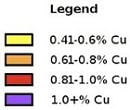
Even though the New Mexico Copper Corporation has decided to use the much more expensive “dry stack” process to extract copper, using about 20 percent of the water it would have used, it will still use a lot of water.
Over the last 15 years the NMCC was unable to convince the court to recognize over 7,000 acre feet per annum in water rights or to obtain the 6,000 AFA of water right it needed to extract copper from the ore using the conventional wet method. The mining site is not that rich in copper (see illustration from NMCC’s website above). It’s a low-grade copper ore and therefore would take a lot of water.
A recent legal ad in the Sentinel gave the official water-use number. The ad gave public notice that the mine is trying to get a “discharge permit” from the New Mexico Environment Department for 1,613,000 gallons a day. That’s 4.95 or almost 5 AFA a day–what nearly 27,000 people would use in a day if average use per person is 60 gallons a day.
If a year consists of 250 working days, the mine will use about 1,237.5 AFA a year. The water use will be 21 percent of the original 6,000 AFA using the wet method, but this is the desert and that is still a lot of water.
According to NMCC’s website, it has only 1,102.21 AFA in water rights:
1,051.56 AFA for mining
34.65 AFA for “pit evaporation”
16 AFA for “livestock and domestic”
4 AFA for a use NMCC’s website calls “NMCC additions”
I spoke with Jordan Anderson who is part of the NMED’s “groundwater quality bureau” that is overseeing the permitting process.
The wet method would have entailed building a huge tailings pond with a dam to keep the toxic water within bounds until it all evaporated away.
The dry stack method (10 times more expensive) means the tailings-pond site won’t need a dam because there won’t be toxic standing water. Instead the site will hold damp toxic sand, which will have a “smaller footprint,” Anderson said, of about 490 acres.
There have been lots of tailings ponds that have breached their dams, polluting rivers and groundwater, so it’s very, very good that NMCC is going to the dry stack method. But the more stable “footprint” of damp toxic sand will still be full of arsenic, lead, cadmium and uranium, which are not good for humans, plants and animals. And 490 acres is close to a square mile or 371 football fields.
Even if the pit’s plastic liner holds and prevents groundwater and downstream river pollution, air pollution will happen from dust blowing around until grass is induced to grow on top. Dry stacking by a less fancy name is “toxic dump site.” It will have to be guarded and monitored for 100 years or so. I hope the permitting agency makes the mining company cover those costs for that long, but I’m sure it won’t.
Local elected officials won’t help either. They have passed resolutions over the years expressing their support of NMCC–when it was going to use 6,000 AFA a year and the mine would be open only 12 years. Jobs, jobs, jobs they cried, exercising zero foresight or care for the people, animals, land and water.
Now, with copper prices and demand rising, and maybe because they can use only 1,100 AFA a year, forcing it to string out the extraction process, NMCC estimates the mine will be open for 20 years with 270 people being employed. https://sierracountycitizen.org/copper-flat-mine-to-use-much-less-water/
But it’s still an Australian company, with most of the profits going out of the country, let alone remaining in state. And it’s still a boom-bust industry that could shut down at any time if copper prices dip too low. The margins for profit are narrow because it’s a low-grade copper ore. That’s why the site has remained dormant since the early 1980s and was closed down after less than a year of operation.
Is that worth the risk and the pollution?
Is it worth risking the repulsion of recreation seekers and tourists?
I bet hiking, biking, birding and other recreational and tourist activities on the 2,200-acre mining site and area would generate more money for locals than the 20 years of mining operation and 100 or maybe more years of toxicity resulting thereafter. The site is close to Hillsboro, Caballo Lake and the Rio Grande.
Mining is not good for tourism because it is not good for the environment. Arizona realized that not only were they repelling people, plants and animals, they were losing money. That state is reversing its enthusiasm and preference for mining over tourism.
Anderson said the permitting process will take six months to a year. If you are interested in being put on a notification list for upcoming permit decisions and public-comment schedules, call 505-827-2900. The NMED also publishes public notices at https://www.env.nm.gov/public-notices/
Thanks so much for this article, Ms. Sloan. I am one of the members in the suit against the reopening of this mine, as I live in Hillsboro. We already have a reduction in ground water due to YEARS of drought. It is, to me, a ridiculous idea to even consider letting the mine use that much ground water. If copper is up, they can have my old pennies. (smile)
I believe copper pennies will be terminated for use by early next year. This will be in accordance with the decree of our King. So, yes, everyone in the US will be scrapping all of those copper coins in the piggy banks. Guess I better do that before the price goes down.
According to Max Yeh’s recent water story, I believe we are so short of water in the river system that irrigation will consist of one watering within the Elephant Butte Irrigation District – one and done. Interesting that I see semi load after semi load of fresh alfalfa headed to the ranches, yet there has been no irrigation from the river. Farmers must be using wells. But is the Water Quality Bureau doing anything to track that usage? Who will monitor the water usage at the Copper Flats Mine?
Things are so dry in the Gila that Monument Spring is almost ready to disappear. The Forest Service even went as far as Stage 2 fire restrictions, which is a rarity.
If we are headed into a recession because of the batshit crazy tariffs one good result of that, I suppose, might be too keep these people from their damn mine, at least for a while.
This is a post from Chris O’Rourke: I think another thing to consider is the company’s balance sheet. Will this company be able to follow through with proper handling when it already shows 197.8% debt to assets as of the end of last year (Q2). The ticker is MACQF if anyone is curious. Perhaps there is some way to have them guarantee funding for follow-through on maintenance and cleanup, instead of going belly up and walking away.
Thanks, Kathleen, for keeping up on this issue. Yes, it it a lot of water, which we should all remember belongs to the people of New Mexico and which we are giving to the mining company to use. This is also true for the copper, gold, and molybdenum. The mining company never paid us for either our water or our minerals. All those claims that make up much of Copper Flat Mine are “private property” only because we gave them to the claimants, and even today, about a fifth of the pit is still BLM land, that is, our land and minerals. Yes, they will be using a lot of our water for free and taking our natural wealth to boot.
But water use is managed by laws, and because we, as citizens, have been very lax about the laws, not being much concerned until the water stops coming out of our taps and letting “interests” control the legal story of water use, the laws are unable to control water use. So, the courts have given NMCC the right to use about 1,100 af of water a year, but if all the rights in this Lower Rio Grande Basin were to exercise their legal rights, the whole basin would go dry. There is more paper water than wet water in this basin. This is to say that even without climate change, there is not enough water to go around.
To me that says several things: 1) the legal and administrative system needs change; and 2) projects that use an inordinate amount of water such as Copper Flat Mine – even using dry stack processing – should not be encouraged to carelessly exercise their “rights.” These “rights,” after all, are not God given but given by us. We need to have some way of judging the appropriateness of using these rights. An administrative venue for such a consideration may not now exist. For example, how will the pumping of 1,100 afy three miles from Caballo Reservoir affect the river flow and the delivery of river water to Texas (in accordance with the Compact)? Unless someone goes to court, no one will answer that question. For that matter, how will having an open pitlake deep into groundwater affect the river flow, part of which is supplied by groundwater flowing from the Black Range to the east?
The legislature has come late to this problem, and even now, their awareness has been the result of a few water advocates and their organizations, today mostly spearheaded by Norm Gaume’s New Mexico Water Advocates. Read his recent posting on how close we, as a state, are to violating the Rio Grande Compact: https://nmwateradvocates.org/from-the-presidents-desk-sliding-closer-to-the-brink/.
Everyone’s use of water affects everyone else’s source. That is what is “common” about water resources.
Those who favor the mine, such as our local elected officials, need to understand the costs of this project not in terms of “jobs” but in terms of our overall need for water to sustain the lives of the people who work those jobs. The groundwater withdrawn for 20 years may not come back, making the future of Sierra County much drier. If it comes back, the right to use that water will not be for the benefit of Sierra County, because those rights will be in the hands of a consortium (already contracted) which will sell the rights on the market at prices we locals cannot afford (the mine, with its access to millions of dollars of debt funding, could not afford to buy more rights in the last 15 years). The certainty of blowing toxic dust all along Animas Creek and Hwy 152 is a cost for us but not for the owners of the mine. Do we really want to cough and wheeze so they can profit, but more important, where do we get to answer that question if government is not into equity and fairness?
Kathleen speaks of the boom and bust cycles of mining. If we pay attention to water use, we see a detailed explanation of why that is an inevitable cycle: mining uses up the natural resources for a short term economic benefit and leaves nothing in its wake to keep the local society going. Ultimately, extraction industries extract life from a locale and ships it elsewhere.