
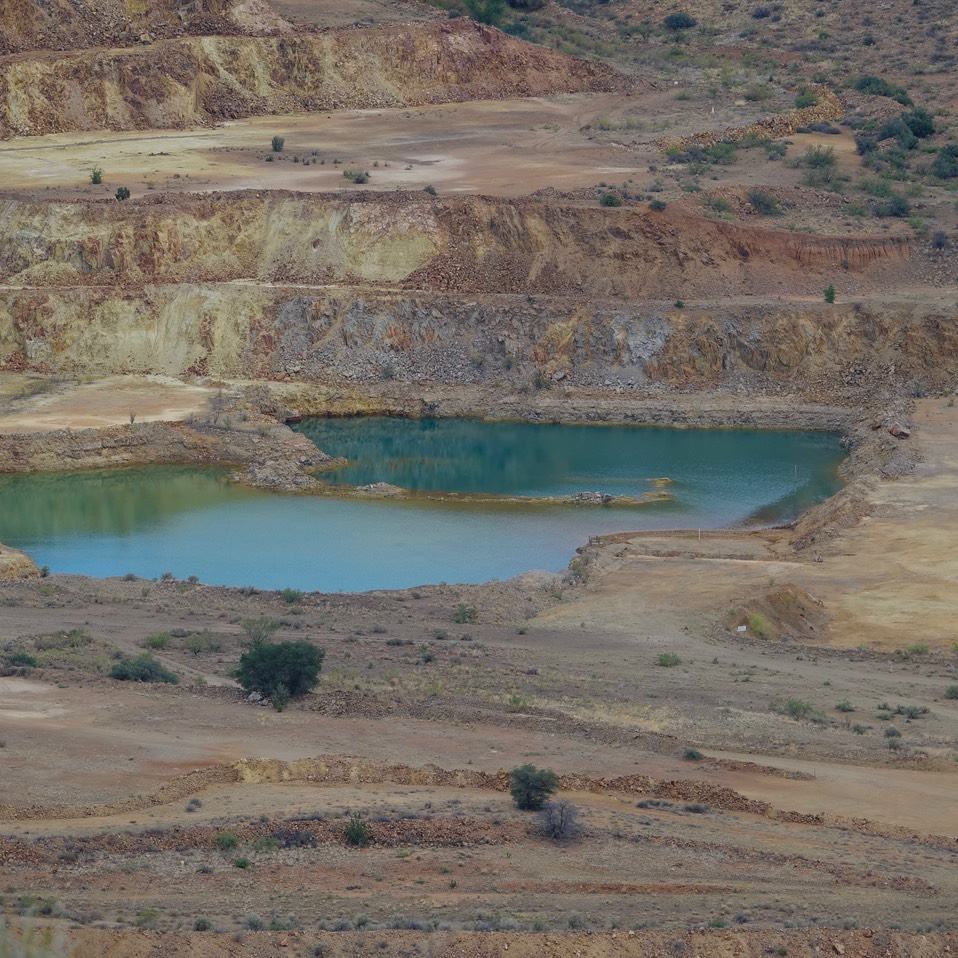

Although I begin with problems related to the tailings storage facility, I think water is still our major issue. It’s just that the mine’s application centers on the dry stack process; so, we have to deal with it. The amended application changes the treatment of the tailings from the use of a tailings pond and a dam to a stack of mechanically dewatered tailings which eventually will be 200 feet thick and cover 500 acres. At eastern, downhill end of the stacks, near Hwy. 152, the stacks slope down in 60 foot steps. The previous danger of tailings going all over the place in a flood is gone. But the whole thing could slide. There will be a small seepage pond to collect seepage from the stacks, because although they are called “dry stacks” by miners, they are wet. That seepage pond will figure in our consideration of water use.
The stability of the stacks depends on the physical qualities of the supporting ground, the internal physical characteristics of the tailings themselves (the tailings are rocks ground to face-powder consistency), and the configuration of the stacks. The mine’s consultants did detailed studies of all three elements. However, they considered their conclusions temporary because the data for them were insufficient. The studies are labeled “pre-feasibility” and are just preliminary studies in which most serious issues are set aside. The study of the soil characteristics, for example, found that most of the various soil types underlying the whole structure was clay, which has very high expansive and contractive qualities, making the base unstable if water gets in. However, these characteristics at depth were based on core drills done by Quintana in 1979 and 1980 which often did not reach more than 40 or 45 feet down. The consultants recommended that for a full soil characteristic study and thus for a dedicated seismic study there should be data from 100 feet below the surface.
Similarly, characteristics of the tailings themselves (slippage, sheering and deformation) were dependent on Quintana tailings or laboratory generated tailings rather than actual production tailings. The shaping of the slopes in the stacking, being dependent on these characteristics, then, would have to be determined at the time of the stacking, undermining the certainty of the theoretical planning.
If there is a soil specialist among you or at least someone familiar with stress bearing qualities of soil in construction engineering, please contact me for a conversation about these studies.
As I said in my first report, these physical issues of structure may be less concerning than the problem of dust because of the chemical makeup of the tailings and because the prevalence of dust storms every spring here. That issue is not addressed at all, except, perhaps, by the information that when the tailings are spread and compacted, they are still in a moist state. It is conceivable that given the right amount and production speed of the tailings, the right size of a bench being constructed, and the speed of spreading and compacting a layer of tailings, all coordinated, that there is never a tailings surface left open to dry into a dust problem before it is covered up with topsoil and seeded. But that would be an amazing feat of coordination. Can this company, which has never itself operated a mine, do that? [Even then, for seeds to grow into vegetation cover, as everyone knows, is somewhat a fantasy in this clime. The staging area on Hwy 152 for the construction of the high voltage transmission line was seeded and covered with straw many months ago. Has anyone seen anything growing there?]
If the miners cannot coordinate the reclamation with the production and laying of the tailings, then exposed drying tailing dust will be a problem for downwinders, and the mine will need to depend on dust control watering to keep dust down, and that brings on the problem of water.
NMCC owns about 1,100 AFY of groundwater rights. According to their Final Environmental Impact Statement (FEIS) on which their federal (BLM) mining permit is based, their 30,000 tons per day operation will need about 22,000 AFY of water. That huge difference between supply and need, presumably, is made up by recycling water over and over, and very rapidly. Using the traditional wet process and pond to store tailings, they had estimated that 15,000 AFY could be recycled. How much more water the dry stack method can recycle is debatable, even though the mine claims an 80% reduction in water use, that number is a bit of a flim-flam.
Industry wide, the dry stack method saves 60% water use at best, and the mine already claimed that their recycling of water from the wet tailings pond could reach 70% water reuse. It sounds like they are going backwards when you look at the details. All the mine’s 80% water savings turns out to mean is that they used to think they had rights to use over 6,095 AFY and now they have rights only to 1,095 AFY. So, the mine doesn’t seem to know what their water savings are, or if they do, they are not saying.
But these considerations of how much water is recycled from the processing water (remember that the copper concentrate is floated in water) are apart from the water used for dust control, because dust control water is entirely evaporated, cannot be part of the cycling and recycling process. This is also true of sanitation water and water used in washing down equipment. In the FEIS, they say they need 968 AFY for these non-processing water needs. Where is that water going to come from? It can’t be pumped out of their wells as part of their 1,095 AFY water rights, since that would only leave 127 AFY of water to cycle and recycle in their production, not possible even with dry stack tailings.
Their environmental statement, the FEIS, however, lists as sources of water “stormwater” (300 AFY) and the curious “moisture in the ore” (250 AFY).
Stormwater is harvested in the present mining plan in three difference ways. The pit catches precipitation not only in itself but catches run-off from the quite large surrounding hills (over 300 acres). The two waste rock piles shed their stormwater into three catchment ponds. The water that falls on the tailing cakes, the contact run-off, will be channeled into the seepage pond at the base of the tailings storage facility. These sources amount to a lot of water. In the FEIS it is counted as 300 AFY but without the run-offs into the pit or from the tailings (which is 500 acres big). In a year (that is how we are calculating, by annual usage), the runoff of 1 foot of water (the average annual rainfall here) from 800 acres, properly channeled, will be very great. It could easily add 500 AFY more. The removal of this much water from the area’s total surface water flows can be significant, yet it has never figured in any hydrological study of impacts that I have seen. We don’t know the downstream impact.
The use of this water is problematic, legally speaking, too. NMCC has no rights to use surface water. It has designated this water as water that has contacted raw ore and thus is polluted. Environmentally, they are right not to allow it into the creek, but I don’t know if you can just take water by polluting it. The Office of the State Engineer (OSE, which administers water in the state) has to have something to say about this extra-legal taking, but it is not involved in the MMD decision on a mining permit. It was not involved in the BLM process that led to the federal permit to mine because it recused itself due to the pending litigation over NMCC’s groundwater rights. For the public, the question is how we get the OSE to make a declaration about the legality of using surface water without rights just because the user pollutes the water. The public should be working on this.
The State Engineer has written to MMD reserving the right to make judgments on the Copper Flat Project and only certifying that the mine owners have rights to use 1,095.21 AFY of groundwater. The OSE is constrained in this matter because it is in the middle of private negotiations with big water users in this water basin (Lower Rio Grande Water Basin) on how to reduce its habitual overuse of groundwater which has short-changed river water for Texas and Mexico. That negotiation will end October 1st, two weeks after this MMD hearing on the mine.
The other source of water identified in the FEIS, moisture in the ore, may be another of these water grabs. I assume, without evidence, that the raw ore contains water because it is mined from below the ground table. The pit, which is the hole left by digging out the ore, is already into groundwater, and as they mine, it will get larger and deeper. Groundwater will seep into the pit, and in order to mine, the water has to be constantly pumped out (a source of dust control water). It’s called “mine dewatering,” and NM has a mine dewatering act which allows well owners near mines to sue for the negative impacts of dewatering. We keep this litigation in the back of our minds. Right now, my point is that the ore is saturated with water; so that, mining ore itself is a form of water extraction and, technically speaking, is depleting the aquifer. Again, this amount of groundwater depletion has never figured in any hydrological study of impacts. I would like to see, again, an OSE decision about this extra-legal method of taking water.
Remember that in the regulatory process, we are faced with an application for a mining permit from the Mining and Minerals Division (MMD) of the NM Energy, Minerals, and Natural Resources Department (NMEMNRD). This agency has jurisdiction over mining but not over water rights and water use. The MMD, however, can set certain requirements about water as conditions for a mining permit. It did this regarding the mine’s original application for mining. In its Director’s Order Withdrawing Order issued March 31, 2020 and Adopting Settlement Agreement, June 5, 2020, the MMD director order that the application processing follow the conditions established by agreement with NMCC, the miners. NMCC agreed, among other things, to find enough water rights to mine at a 30,000 tons of ore per day rate, which at that time was thought to be 6,095 AFY. The order allowed amending the mining plan but did not specify how. Now that the mine’s water rights are reduced to 1,095 AFY, it will be interesting after the hearing to see if MMD will abide by that order and hold NMCC to demonstrating that it has sufficient water rights in hand to operate.
Do you think it’s a done deal with this will be approved and mining will begin , or is there a chance it can be shut down?
Mr. Blanco,
I wish I knew. The mine holds the strategic cards, and both the state regulators and the public can only respond. This is one reason why it is important, win or lose, to comment at the upcoming hearing, either in person or by writing. Comments go into the permanent record of the review process and can then be used, by either side, in a litigation, if it comes to that.
It should be remembered that PAWA (Perch/Animas Watershed Association, where I am board president), the Ladder Ranch, the Hillsboro Pitchfork Ranch, and EBID (Elephant Butte Irrigation District) have litigated twice with the mine over water issues and have won twice.
At the same time, there are outside events which can shift the ground under everyone’s feet. Among these are the rapidity of climate change (no rain, no water, no mine) and the resolution to the issue of how the people in the Lower Rio Grande Water Basin (along the river from Elephant Butte to Mexico and Texas) will have to give up 18,200 AFY of water rights. People in southern NM (that is us) will have to give up water use voluntarily, persuaded to give it up, or mandated by the state to give up those rights to use that much water.
There are a lot of factors. It’s not all just power and money and politics. I will be writing about all this in detail in upcoming posts.
re seeding–i was on the citizen review committee for the superfund site of the Questa NM Moly Mine and we were given a tour of the waste rock pile–comprised of rocks about the size of big chunk of firewood. the gal leading us—a miner–pulled up to a slope and got out the car and got us directed to look at the “reclaimed” slope. everyone did a 360 scan but no she actually meant this pile of rocks with one green bush on it.
we giggled and she continued to smile